
Agrotis malefida
Guenée, 1852
Rascal Dart, Palesided Cutworm
Agrotis malefida, commonly known as the rascal dart or palesided , is a noctuid distributed across the southern United States and throughout the Neotropics from Mexico to Argentina and Chile. The species exhibits notable seasonal variation in , appearing in late January in northern portions of its range while flying year-round in southern regions. Larvae are significant agricultural pests, feeding on a broad range of broad-leaved herbaceous plants and causing damage to major crops including corn, cotton, and various vegetables.

Pronunciation
How to pronounce Agrotis malefida: /əˈɡroʊtɪs mæˈlɛfɪdə/
These audio files are automatically generated. While they are not always 100% accurate, they are a good starting point.
Identification
The specific wing measurements and the 'palesided ' suggest pale lateral markings may be present, though no detailed diagnostic features distinguishing it from are documented in available sources.
Images
Appearance
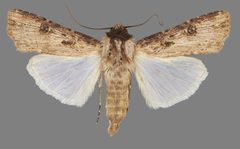
have a wingspan of 40–50 mm (1.6–2.0 in), with forewings measuring 18–23 mm (0.71–0.91 in).
Habitat
Found in diverse environments across its broad geographic range, from temperate regions in the southern United States to tropical and subtropical zones throughout the Neotropics. Specific microhabitat preferences for or larvae are not documented.
Distribution
Native to North America and the Neotropics. In the United States, occurs from North Carolina and Kentucky south to Florida, west to Arizona, and north to southern Kansas. Also present throughout the Neotropics from Mexico to Argentina and Chile, including the Falkland Islands.
Seasonality
emerge in late January in the northern part of the range. In southern regions, adults fly throughout the year with no distinct seasonal peak.
Diet
Larvae are herbivores feeding on broad-leaved herbaceous plants. Documented include Brassica oleracea (cabbage), Trifolium (clover), Fabaceae (legumes), Allium (onion/garlic), Pisum sativum (pea), Capsicum (pepper), Solanum tuberosum (potato), Nicotiana (tobacco), Solanum lycopersicum (tomato), and various weeds. Considered a pest on Zea mays (corn) and Gossypium (cotton).
Host Associations
- Brassica oleracea - larval food plant
- Trifolium - larval food plant
- Fabaceae - larval food plant
- Allium - larval food plant
- Pisum sativum - larval food plant
- Capsicum - larval food plant
- Solanum tuberosum - larval food plant
- Nicotiana - larval food plant
- Solanum lycopersicum - larval food plant
- Zea mays - larval food plant, major pest
- Gossypium - larval food plant, major pest
Life Cycle
Complete with , larval, pupal, and stages. Eggs are laid in soil or on plant stems and leaves. Larvae hatch in 2–14 days and are typical cutworms—plump, grayish to brownish, curling into a C-shape when disturbed. Fully grown larvae reach 1–2 inches in length. occurs in soil. Some individuals overwinter as pupae, others as adults, but most overwinter as small larvae in soil or grass clumps. Larvae feed underground during daytime and emerge to feed at night.
Behavior
Larvae exhibit classic : surface feeding that severs plant stems at, slightly below, or slightly above the soil surface. Larvae remain hidden in soil during daylight hours. are nocturnal fliers.
Ecological Role
Larvae function as primary consumers of herbaceous vegetation. As a herbivore across a broad geographic range, the likely serves as prey for various vertebrate and , though specific predator relationships are not documented.
Human Relevance
Significant agricultural pest. Larvae damage multiple economically important crops including corn, cotton, cabbage, tomato, potato, pepper, pea, and tobacco. Management relies on cultural practices (weed control, seedbed preparation, tillage) and applications, with timing optimized for late afternoon when larvae are near the soil surface. Insecticidal baits and broadcast ground applications are used, with banded applications at planting for subterranean larvae.
Similar Taxa
- Agrotis ipsilon (Black Cutworm)Similar and pest status; distinguished by specific wing patterns and geographic distribution patterns
- Agrotis orthogonia (Pale Western Cutworm)Subterranean feeding habit and similar larval form; differs in preference for loose, sandy, dry soils and more western distribution
- Euxoa spp.Shared noctuid and agricultural pest status; separation requires examination of genitalia or detailed wing pattern analysis
More Details
Taxonomic stability
The has maintained stable since original description by Guenée in 1852, with no documented synonymy or subspecific classification.
Collection records
Over 2,000 observation records documented on iNaturalist, indicating the is relatively well-observed and photographed by naturalists within its range.
Sources and further reading
- BugGuide
- Wikipedia
- GBIF taxonomy match
- iNaturalist taxon
- NCBI Taxonomy
- Catalogue of Life
- Congrats to Antoine Abrieux, Innovator Fellow Award | Bug Squad
- Occasional Pests - AgriLife Extension Entomology
- Encyrtid Holdings | Entomology Research Museum
- Stem- and Leaf- Feeding Insects - AgriLife Extension Entomology
- Antoine Brieux to Share PPTM Research on Fruit Fly | Bug Squad
- Insect-resistant Maize Could Increase Yields and Decrease Pesticide Use in Mexico