
Orthodes majuscula
Herrich-Schäffer, 1868
Rustic Quaker
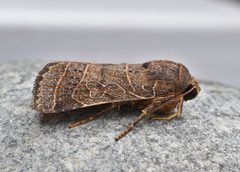
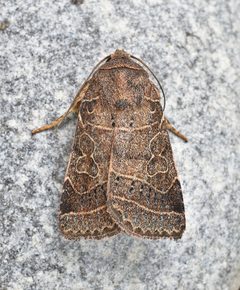
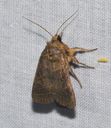
Orthodes majuscula, commonly known as the Rustic Quaker, is a noctuid described by Herrich-Schäffer in 1868. It is widespread throughout the New World, ranging from eastern North America through Central America to South America. are active from May to August and have a wingspan of 28–35 mm.
Pronunciation
How to pronounce Orthodes majuscula: /ɔːrˈθoʊdiːz məˈdʒʌskjʊlə/
These audio files are automatically generated. While they are not always 100% accurate, they are a good starting point.
Identification
Can be distinguished from other Orthodes by genitalia examination; specific external diagnostic features not documented in available sources. The combination of its broad New World distribution and May–August period in northern regions may aid in narrowing identification.
Images
Distribution
Widespread throughout the New World: eastern North America from Nova Scotia south to Florida, west to Arizona, north to Alberta and the prairie provinces (Saskatchewan, Manitoba); also recorded from Cuba, Mexico, Rica, and Brazil.
Seasonality
are on wing from May to August in northern parts of its range; timing in tropical portions of its range is not documented.
Diet
Larvae feed on a wide range of herbaceous plants including dandelion (Taraxacum), plantain (Plantago), various grasses (Poaceae), and willow (Salix). feeding habits are not documented.
Host Associations
- Taraxacum - larval food plantdandelion
- Plantago - larval food plantplantain
- Poaceae - larval food plantgrasses
- Salix - larval food plantwillow
Life Cycle
Complete with , larva, pupa, and stages. Specific details of egg deposition, larval instars, site, and stage are not documented in available sources.
Behavior
; attracted to light. Specific behavioral details beyond period are not documented.
Ecological Role
Larvae function as herbivores feeding on low-growing plants. may serve as prey for and as potential , though specific ecological interactions are not documented.
Human Relevance
No documented economic or agricultural significance. Occasionally encountered by enthusiasts and in biodiversity surveys.
Similar Taxa
- Other Orthodes species-level similarity in appearance; accurate identification typically requires examination of genitalia.
- Other Noctuinae mothsShared characteristics including stout bodies and cryptic forewing patterns; distinguished by technical features and distribution.
More Details
Taxonomic history
First described by Gottlieb August Wilhelm Herrich-Schäffer in 1868.
Observation data
Over 4,300 observations recorded on iNaturalist, indicating it is frequently encountered and photographed by citizen scientists.