
Nudorthodes variabilis
(Barnes & McDunnough, 1912)
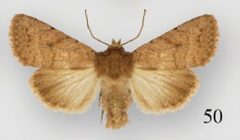
Nudorthodes variabilis is a noctuid described by Barnes and McDunnough in 1912. It is restricted to the coastal region of southern California, ranging from Santa Barbara County to San Diego County. The is characterized by distinctive forewing markings, including a prominent medial line and a well-defined dark blue-gray patch in the lower portion of the spot. are active in late summer, with records from late August to mid-September.
Pronunciation
How to pronounce Nudorthodes variabilis: //nuːdˈɔːrθoʊdiːz ˌvɛəriəˈbɪlɪs//
These audio files are automatically generated. While they are not always 100% accurate, they are a good starting point.
Identification
Distinguished from similar noctuid by the combination of: (1) the prominent medial line that runs obliquely from to spot then straight to hind margin, and (2) the well-defined dark blue-gray patch restricted to the lower third of the reniform spot. The even gray-brown ground color and small size (forewing 13–14 mm) are additional distinguishing features. Geographic restriction to southern California coastal counties helps separate it from related with broader distributions.
Images
Appearance
Small with forewing length of 13–14 mm. Forewing ground color is typically an even gray-brown, occasionally with a slight reddish tint. The medial line is usually prominent, extending obliquely from the to the spot, then continuing as a straight line to the hind margin. The lower third of the reniform spot contains a well-defined dark blue-gray patch. Hindwings and body details are not described in available sources.
Habitat
Coastal of southern California. Specific microhabitat preferences are not documented, but the ' distribution along the coast from Santa Barbara to San Diego Counties suggests association with coastal scrub, chaparral, or similar Mediterranean-type vegetation found in this region.
Distribution
to the coastal region of southern California, United States. Documented from Santa Barbara County south to San Diego County.
Seasonality
have been recorded on wing from late August to mid-September. Larval is unknown.
Life Cycle
Complete with , larva, pupa, and stages. Details of larval development, , and number of per year are unknown.
Behavior
are . Specific such as attraction to light, patterns, or mating habits are not documented.
Similar Taxa
- Other Nudorthodes speciesSimilar size and general appearance; distinguished by specific forewing pattern elements, particularly the configuration of the medial line and spot markings
- Related Noctuinae in southern CaliforniaMany small noctuids share gray-brown coloration; N. variabilis is separable by the combination of prominent oblique medial line and dark blue-gray patch in the spot, plus its restricted coastal distribution
More Details
Taxonomic history
Originally described by William Barnes and James Halliday McDunnough in 1912. The has been treated as Protorthodes variabilis in some classifications, but Catalogue of Life currently lists it as accepted in the Nudorthodes.
Conservation status
Not evaluated; restricted range in developed coastal California may warrant attention, but no specific threats documented.
Sources and further reading
- BugGuide
- Wikipedia
- GBIF taxonomy match
- iNaturalist taxon
- Catalogue of Life
- Just in the tick of time: American dog tick, Dermacentor variabilis, and Black-legged tick, Ixodes scapularis — Bug of the Week
- A trio of trouble – Black-legged ticks Ixodes spp., American dog tick Dermacentor variabilis, and lone star tick Amblyomma americanum — Bug of the Week
- Time for ticks: Lone star tick, Amblyomma americanum, Blacklegged ticks, Ixodes spp., and American dog tick, Dermacentor variabilis — Bug of the Week
- A trio of trouble just in time for summer: Blacklegged ticks, Ixodes spp.; American dog tick, Dermacentor variabilis; and lone star tick, Amblyomma americanum — Bug of the Week
- Study Shows American Dog Ticks in Western U.S. Are a Separate Species
- Don’t Get Too Attached: New Research on Grace Period for Tick-Borne Spotted Fevers