
Nudorthodes texana
(Smith, 1900)
Nudorthodes texana is a noctuid first described by Smith in 1900. It occurs across the western and southwestern United States, from the intermontane region of the Pacific Northwest south to California and Arizona, and east to the Gulf Coast of Texas. The inhabits steppe regions, wet meadows, and agricultural fields including alfalfa. are active in two per year, with periods in March and from mid-August to mid-November.

Pronunciation
How to pronounce Nudorthodes texana: //njuːˈdɔrˌθoʊdiːz tɛkˈsɑːnə//
These audio files are automatically generated. While they are not always 100% accurate, they are a good starting point.
Identification
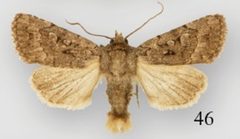
Distinguished from similar noctuine by the combination of small size (forewings 12–14 mm), pale buffy brown to gray-brown ground color, and the specific pattern of darker shading concentrated around the and spots and outer subterminal area. The pattern may aid in identification where data are available.
Images
Appearance
Forewing length 12–14 mm. Forewings pale buffy brown to gray-brown with darker shading surrounding the and spots and in the outer portion of the subterminal area.
Habitat
Steppe regions, wet meadows, and alfalfa fields. Associated with open, herbaceous-dominated landscapes in arid to semi-arid regions of western North America.
Distribution
United States: intermontane region of Washington, Oregon, Nevada, and Utah; southward to southern California and Arizona; southeastward to the Gulf Coast of Texas.
Seasonality
Two per year. recorded on wing in March and from mid-August to mid-November.
Host Associations
- herbaceous plants - larval food sourceprobable; specific unconfirmed
- alfalfa - larval food sourcepossible; inferred from association
Human Relevance
Presence in alfalfa fields suggests potential as an agricultural inhabitant, though specific pest status has not been documented.
Similar Taxa
- other Nudorthodes speciessimilar size and general noctuine ; requires examination of genitalia or detailed wing pattern analysis for definitive separation
- Protorthodes specieshistorically placed in this ; closely related and morphologically similar, necessitating careful study of diagnostic characters
More Details
Taxonomic history
Originally described as Perigea texana by Smith in 1900. Subsequently transferred to Protorthodes, and currently placed in Nudorthodes based on revised generic concepts within the Eriopygini.
Nomenclatural note
Some sources list this as a synonym of Protorthodes texana, but Catalogue of Life and NCBI recognize Nudorthodes texana as the accepted name.