
Lacinipolia pensilis
(Grote, 1874)
Lacinipolia pensilis is a of owlet moth in the Noctuidae, distributed across the western cordilleran region of North America. are active from August to September and are attracted to lights. The species can be distinguished from close relatives by its well-defined forewing markings and richer brown coloration. Larvae are thought to be ground-dwelling feeders on shrubs and herbs.
Pronunciation
How to pronounce Lacinipolia pensilis: //ləˌsɪnɪˈpoʊliə ˈpɛnsɪlɪs//
These audio files are automatically generated. While they are not always 100% accurate, they are a good starting point.
Identification
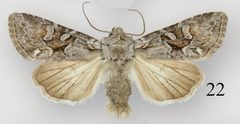
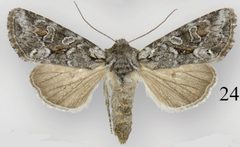
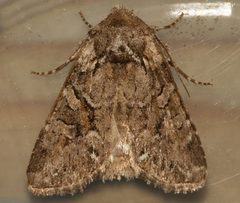
Distinguished from the similar Lacinipolia acutipennis by more sharply defined forewing markings, deeper brown coloration in the medial forewing area, and absence of pale streaky patches in the region. Also slightly larger with a broader forewing. Visual identification to within the Lacinipolia is challenging and may require examination of genitalia or other microscopic features.
Images
Appearance
are slightly larger than related with broader forewings. The forewings display well-defined markings with richer brown tones in the medial area. Unlike some , the forewing area lacks streaky pale patches. The overall coloration includes mottled gray patterns with reflective on the wings.
Habitat
Western cordilleran region; specific microhabitat preferences for unknown. Larvae probably ground-dwelling among low vegetation.
Distribution
Western cordilleran region of North America from central British Columbia and western Alberta southward to at least Washington and central Utah. Records also include Manitoba.
Seasonality
active from August to September.
Diet
Larvae are probably general feeders on shrubs and herbs. feeding habits unknown.
Life Cycle
Complete with , larva, pupa, and stages. Larvae are ground-dwelling. Specific details of site and stage unknown.
Behavior
are and attracted to lights. Larval poorly documented but presumed to feed on low-growing vegetation.
Similar Taxa
- Lacinipolia acutipennisVery similar in overall appearance but has less well-defined forewing markings, paler tones, and streaky pale patches in the forewing area that L. pensilis lacks. Also slightly smaller with narrower forewings.
More Details
Taxonomic History
Originally described as Dianthoecia pensilis by Grote in 1874 before transfer to Lacinipolia.
Identification Challenges
in the Lacinipolia are difficult to distinguish visually; the observation that 'one cannot tell the species apart just by looking' has been noted for this genus.