
Hypotrix lunata
(Smith, 1906)
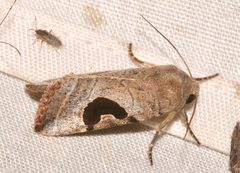
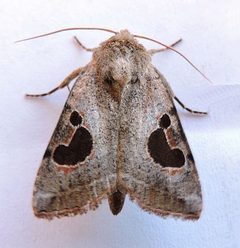
Hypotrix lunata is a noctuid described by Smith in 1906. It is restricted to the southwestern United States and northern Mexico, with records from the Chiricahua, Huachuca, and Santa Rita Mountains in Arizona south to Durango, Mexico. The is notable for its distinctive wing pattern featuring black and spots that form a characteristic mark. It is superficially unlike any other North American noctuid species, making it relatively easy to identify in the field.

Pronunciation
How to pronounce Hypotrix lunata: /haɪˈpoʊtrɪks luˈneɪtə/
These audio files are automatically generated. While they are not always 100% accurate, they are a good starting point.
Identification
Distinguished from all other North American Noctuidae by the combination of black and spots forming a V-shaped mark, even black postmedial line, obscure basal line, and fuscous hindwing. Most similar to Hypotrix quindiensis (South America), which has larger orbicular spot with unequal sides, irregular postmedial line of dashes ending in a costal spot, contrasting black basal spot, and dirty white hindwing. Male genitalia differ from H. hueco in having only expansion of uncus (vs. apical 2/3 wide), stouter and abruptly tapered clasper, larger lobe on sacculus, three tight medial coils in vesica with extensive basal spine cluster (vs. one coil), and corresponding three coils in female appendix bursae with more heavily sclerotized ductus bursae.
Images
Distribution
Southeastern Arizona (Chiricahua, Huachuca, and Santa Rita Mountains) southward to the State of Durango in northern Mexico.
Similar Taxa
- Hypotrix quindiensisOriginally described as a form of H. lunata; differs in larger spot with unequal sides, irregular postmedial dashes ending in costal spot, contrasting black basal spot, and dirty white hindwing; also differs in genitalia with two vesica coils and partially sclerotized ductus bursae.
- Hypotrix huecoMost similar male genitalia in North American fauna; differs in uncus shape, clasper proportions, sacculus lobe size, vesica coil number and spine arrangement, and female genitalia .
- Hypotrix purpurigeraShares black and spots that may be posteriorly, but is a South American not overlapping in range.