
Papaipema duovata
Bird, 1902
Seaside Goldenrod Borer Moth, Seaside Goldenrod Stem Borer
Papaipema duovata is a noctuid specialized on seaside goldenrod. are active in October and have a wingspan of approximately 36 mm. The is listed as threatened in Connecticut. It was first described by Henry Bird in 1902 from specimens originally placed in Hydroecia.
Pronunciation
How to pronounce Papaipema duovata: //ˌpæp.aɪˈpiː.mə duːˈoʊ.vɑː.tə//
These audio files are automatically generated. While they are not always 100% accurate, they are a good starting point.
Identification
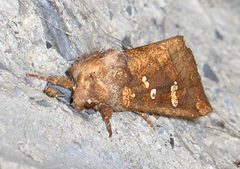
Combination of dusky brown ground color with contrasting white , , and claviform spots distinguishes . Dull yellow basal spots provide additional marking. October period and coastal association aid identification. Larval presence confirmed by boring damage in Solidago sempervirens stems.
Images
Appearance
are dusky brown with white , and claviform spots. Dull yellow basal spots are present on the forewings. Wingspan measures approximately 36 mm.
Habitat
Coastal plain environments. Associated with plant stands of seaside goldenrod in coastal .
Distribution
Native to North American coastal plain. Range extends from Gulf Coast north to at least New Jersey. Present in Connecticut where it holds threatened status.
Seasonality
are on wing primarily in October. Larval activity within stems presumably occurs prior to adult .
Diet
Larvae bore into and feed within stems of Solidago sempervirens (seaside goldenrod). feeding habits are not documented.
Host Associations
- Solidago sempervirens - larval Larvae bore into stems
Life Cycle
Larval stage develops inside stems of Solidago sempervirens. presumably occurs within stems or nearby substrate. emerge in October. Specific details of placement and stage are not documented.
Behavior
Larvae are stem borers, tunneling within Solidago sempervirens stems. are . No other are documented.
Ecological Role
As a herbivore, larvae modify goldenrod stems through boring activity. Specific effects on plant or broader function are not documented.
Human Relevance
Listed as threatened in Connecticut, indicating conservation concern. No economic or agricultural significance is documented.
Similar Taxa
- Other Papaipema speciesShare -level traits including stem-boring larvae and noctuid ; distinguished by specificity, spot pattern details, and geographic range
More Details
Taxonomic History
Originally described as Hydroecia duovata by Henry Bird in May 1902. Subsequently transferred to Papaipema.
Conservation Status
Threatened in Connecticut. trends and threats elsewhere in range are not documented.