
Hydraecia micacea
Esper, 1789
Rosy Rustic, Potato Stem Borer
Hydraecia micacea, known as the rosy rustic or potato stem borer, is a noctuid native to the and introduced to eastern North America. The exhibits significant agricultural pest status, particularly affecting hop and potato crops through subterranean larval feeding on roots and crowns. are active from July to November in temperate regions. The species is with a single per year.
Pronunciation
How to pronounce Hydraecia micacea: /haɪˈdrisiə maɪˈkeɪʃə/
These audio files are automatically generated. While they are not always 100% accurate, they are a good starting point.
Identification
Reliable identification from similar European Hydraecia (H. ultima and H. nordstroemi) requires genital examination; external is insufficient for definitive determination. Within its range, distinguished from H. immanis (hop-vine borer) by specific morphological and molecular characteristics. The -tinged forewings and luteous hindwings provide tentative field recognition, but confirmation necessitates dissection.
Images
Appearance
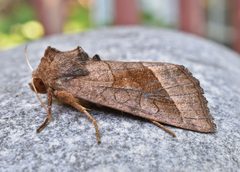
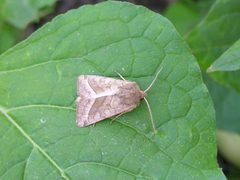
Forewings variable in ground color from pale greyish-ochreous to dark grey or brownish-grey with strong tinge; area darker, suffused with olive brownish except along and inner margin; inner and outer lines brown; upper stigmata large with fine brown outline; submarginal line variable, sharply angled on 7; hindwing luteous, generally grey-tinged with dark outer line and submarginal cloud. Wingspan 28–45 mm; forewing length 14–21 mm. Larva reddish flesh color with deeper line, yellowish sides with black-dotted lateral line above feet, black and , yellowish thoracic and anal plates, shining red-brown .
Habitat
Agricultural and semi-natural including hop gardens, potato fields, and areas with herbaceous vegetation; larvae occupy subterranean environments within plant root systems and crowns.
Distribution
Native across the from Ireland to Siberia (excluding southern areas), extending to Japan. Introduced to eastern North America including Quebec, Ontario (Ottawa), and the northeastern United States. Present in Belgium at regional .
Seasonality
period from early July to November; single per year. laying occurs in autumn. Larval activity from spring through summer, with in July–August. Exact timing varies geographically; Belgian and Dutch records indicate July–November flight season.
Diet
Larvae feed on roots and crowns of herbaceous plants including Humulus lupulus (hop), Solanum tuberosum (potato), and a wide variety of other herbaceous ; feeding is subterranean.
Host Associations
- Humulus lupulus - larval roots and crowns; significant agricultural pest in hop
- Solanum tuberosum - larval stems and roots; females call from concealed positions within potato stems
Life Cycle
. laid on plant stems in autumn, until hatching in early May. Larvae initially tunnel in host bines (April–June), then feed subterraneously on roots and crowns through spring and summer. occurs in soil near damaged plants during July–August. emerge late summer to autumn. Complete cycle spans approximately one year.
Behavior
Females exhibit calling beginning on the first night after , with peak activity 2–4 hours into scotophase; calling duration increases with age, reaching maximum on night 3. Females call from concealed positions within stems rather than exposed locations. Males are attracted to calling females. Larvae exhibit subterranean feeding habit, tunneling into root tissues and crowns. activity typical of Noctuidae.
Ecological Role
Agricultural pest causing significant economic damage to hop and potato through destruction of root systems and crowns; larval tunneling may predispose plants to secondary by Fusarium canker.
Human Relevance
Significant agricultural pest of hops and potatoes; economic losses documented in European hop gardens and North American potato fields. Chemical control with historically effective; modern approaches developed. sequenced for research purposes (Wellcome Sanger Institute, 2023).
Similar Taxa
- Hydraecia ultimaOverlapping distribution in Europe; external very similar; requires genital examination for reliable separation
- Hydraecia nordstroemiOverlapping distribution in Europe; external very similar; requires genital examination for reliable separation
- Hydraecia immanisSympatric in North America; historically confused with H. micacea; distinguished by morphological and molecular characteristics
More Details
Genome Resources
Reference sequenced and published by the Darwin Tree of Life project (Wellcome Sanger Institute, 2023); available through public repositories.
Sources and further reading
- BugGuide
- Wikipedia
- GBIF taxonomy match
- iNaturalist taxon
- NCBI Taxonomy
- Catalogue of Life
- Biology, Damage and Control of Rosy Rnstic Moth, Hydraecia micacea (Esp.), on Hops
- Calling Behavior of the Potato Stem Borer, Hydraecia micacea Esper (Lepidoptera: Noctuidae), in the Laboratory and the Field
- Biology and Phenology of the Hop-vine Borer, Hydraecia immanis Guenée, and Detection of the Potato Stem Borer, H. micacea (Esper) (Lepidoptera: Noctuidae), in Wisconsin
- The genome sequence of the rosy rustic, Hydraecia micacea (Esper, 1789).