
Globia subflava
Grote, 1882
Yellow Sedge Borer Moth, Subflava Sedge Borer
Globia subflava is a noctuid native to North America, commonly known as the yellow sedge borer or subflava sedge borer. The was described by Augustus Radcliffe Grote in 1882 and is characterized by its stem-boring larval habit in wetland plants. are active in mid-summer with a single .
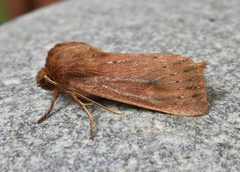
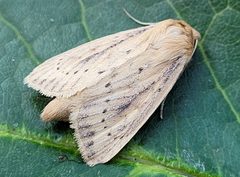
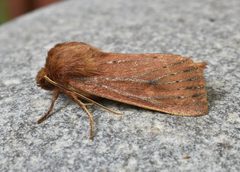
Pronunciation
How to pronounce Globia subflava: /ˈɡloʊ.bi.ə sʌbˈflæv.ə/
These audio files are automatically generated. While they are not always 100% accurate, they are a good starting point.
Identification
Distinguished from related Globia by the yellowish (subflava = 'somewhat yellow') forewing ground color, as opposed to the grayer or browner tones of G. alhambrana and G. sparganii. Best separated by genitalia examination; male G. subflava has distinctive valvae structure. Larval association with Typha and Scirpus supports identification in areas where multiple Globia species co-occur.
Images
Appearance
Medium-sized with wingspan of 35–40 mm. Forewings are yellowish-brown to ochre with variable darker markings. Hindwings are pale, often whitish or light gray. Body is relatively stout, typical of Noctuidae. in : males have bipectinate (feathery) antennae, females have (thread-like) antennae.
Habitat
Freshwater wetlands, marshes, and lake margins where plants grow. Associated with emergent vegetation zones of ponds, slow-moving streams, and ditches. Requires standing water or saturated soils to support Typha and Scirpus .
Distribution
North America: Nova Scotia to British Columbia, south to New Jersey in the east and Utah and California in the west. Core range spans the Canadian provinces and northern United States, with scattered records southward in montane and coastal regions.
Seasonality
active in July, with timing varying by latitude and elevation. (one per year). Larval stage occurs in late summer through following spring, with in early summer.
Diet
Larvae bore into stems of Typha (cattails) and Scirpus (bulrushes), feeding on pith and inner stem tissues. feeding habits unknown; likely nectar-feeding or non-feeding as in related noctuids.
Host Associations
- Typha - larval stem borer
- Scirpus - larval stem borer
Life Cycle
Complete with four stages: , larva, pupa, . Eggs laid on or near plants. Larvae bore into stems, in this stage. occurs within stem or in soil at base of plant. Single per year; adults emerge in mid-summer.
Behavior
Larvae are concealed feeders, tunneling within stems of emergent aquatic plants. This cryptic habit provides protection from and desiccation. are , attracted to light. Mating and oviposition likely occur near larval stands.
Ecological Role
Stem-boring habit creates entry points for and secondary decomposers, accelerating breakdown of wetland vegetation. Serves as prey for wetland-associated birds, , and . Contributes to nutrient cycling in freshwater marsh through herbivory and larval tunneling.
Human Relevance
No significant economic impact. Occasionally of interest to lepidopterists and wetland ecologists. Not a pest of cultivated crops. Scientific value as a model for studying wetland insect-plant interactions and climate change effects on .
Similar Taxa
- Globia alhambranaOverlapping range and similar size; distinguished by grayer forewing coloration and different male genitalia
- Globia sparganiiAlso bores Typha stems; larger with more contrasting wing pattern and different genitalia
- Archanara dissolutaFormerly congeneric; similar but with more diffuse wing markings and different larval preferences
More Details
Taxonomic History
Formerly placed in Archanara; transferred to Globia based on morphological and molecular studies. The combination Archanara subflava appears in older literature and some databases.
Conservation Status
Not formally assessed. Wetland loss represents primary threat; locally vulnerable where marsh drainage occurs. Climate change may affect phenological synchrony with plants.