
Globia
Fibiger, Zilli, Ronkay, L. & Goldstein, 2010
arches
Species Guides
3- Globia laeta(red sedge borer)
- Globia oblonga(Oblong Sedge Borer Moth)
- Globia subflava(Yellow Sedge Borer Moth)
Globia is a of noctuid commonly called "arches", containing approximately seven described . The genus was established in 2010 to replace the preoccupied name Capsula, which itself had replaced Archanara. Species in this genus are distributed across the Holarctic region. Several species have undergone notable range expansions in recent decades, particularly in Britain.
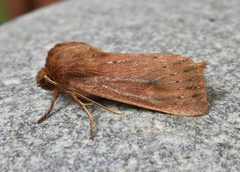
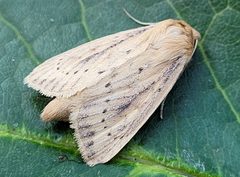
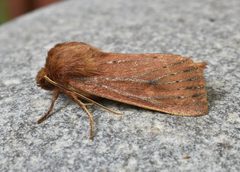
Pronunciation
How to pronounce Globia: /ˈɡloʊ.bi.ə/
These audio files are automatically generated. While they are not always 100% accurate, they are a good starting point.
Identification
The Globia is characterized by relatively small to medium-sized noctuid with distinctive forewing patterns. In Globia sparganii, a small white kidney mark ( stigma) is enclosed by a black rim and forms part of a dark central streak running down the wing. The overall coloration is pale buff. -level identification requires examination of genitalia and subtle wing pattern differences.
Images
Habitat
Associated with freshwater wetlands including marshes, ponds, and ditches. Larval is specifically tied to emergent vegetation in these systems. are known to wander considerable distances from suitable breeding habitat.
Distribution
Holarctic distribution spanning North America and Eurasia. In Europe, records exist from Denmark, Norway, and Sweden. In North America, documented from Vermont and other US localities. In Britain, historically localized to south coasts of England and Wales, with significant range expansion across South-east England and East Anglia since the 1990s; Kent serves as a current stronghold.
Seasonality
on wing from July to October. Larval development occurs within plant stems during the growing season.
Diet
Larvae feed internally in stems of emergent freshwater plants including bulrushes, Bur-reed (Sparganium), and Yellow Flag Iris. Specific associations vary by .
Host Associations
- Sparganium - larval Bur-reed; primary for multiple
- Iris pseudacorus - larval Yellow Flag Iris
Life Cycle
Complete with larval stage spent feeding within stems of plants. presumably occurs in soil or plant debris, though specific details are not well documented for most .
Behavior
are known to wander far from suitable breeding , potentially facilitating range expansion. activity pattern typical of Noctuidae.
Ecological Role
Larvae function as stem borers in emergent wetland vegetation, potentially influencing plant in dense stands. Role in as prey for birds, bats, and other .
Human Relevance
Subject of genomic research; Globia sparganii sequenced as part of the Darwin Tree of Life project. Some of conservation interest due to wetland specialization and documented declines followed by recent recoveries.
Similar Taxa
- ArchanaraFormerly included now in Globia; distinguished by revised generic concepts based on genitalia and molecular data
- CapsulaPreoccupied name replaced by Globia due to homonymy with a mollusk
More Details
Nomenclatural history
This has undergone multiple name changes due to taxonomic revisions and nomenclatural conflicts. The original classification in Archanara was followed by transfer to Capsula, which was subsequently replaced by Globia in 2010 when the name Capsula was found to be preoccupied by a mollusk genus.
Genomic resources
High-quality assembly available for Globia sparganii: 676.7 Mb span, 31 chromosomal pseudomolecules (30 + Z), 18,385 protein-coding genes, QV 65, 100% k-mer completeness, 99.0% BUSCO completeness.