
Globia laeta
Morrison, 1875
red sedge borer, red sedge borer moth
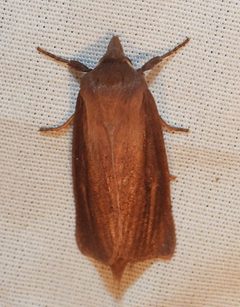
Globia laeta, commonly known as the red sedge borer, is a small noctuid native to eastern North America. The was first described by Herbert Knowles Morrison in 1875 and was formerly placed in the Capsula before that name was changed to Globia due to a preoccupied mollusk genus. The moth is notable for its specialized larval habit of boring into the stems of Sparganium (bur-reed) plants.
Pronunciation
How to pronounce Globia laeta: /ˈɡloʊ.bi.ə ˈleɪ.tə/
These audio files are automatically generated. While they are not always 100% accurate, they are a good starting point.
Identification
The can be distinguished from similar noctuid by its association with Sparganium plants and its relatively small size. Formerly classified under Capsula and Archanara, specimens may be encountered under these synonyms in older collections and literature. Accurate identification may require examination of genitalia or molecular confirmation.
Images
Appearance
have a wingspan of approximately 28 mm. Specific coloration and pattern details are not well documented in available sources.
Habitat
Associated with wetlands and aquatic margins where Sparganium (bur-reed) grows. The larval is specifically the stems of Sparganium .
Distribution
Eastern North America. Documented from Ohio, Illinois, New Jersey, and Ontario, Canada. The full extent of its range is not completely characterized.
Seasonality
are active from July to September, with exact timing varying by location.
Diet
Larvae bore into and feed within the stems of Sparganium (bur-reeds). feeding habits are not documented.
Host Associations
- Sparganium - larval plantlarvae bore into stems
Life Cycle
Larval development occurs inside Sparganium stems. emerge in mid to late summer. Specific details of placement, , and stage are not documented.
Behavior
Larvae are stem borers, living concealed within plant tissue. is poorly documented.
Ecological Role
As a herbivore on Sparganium, the likely plays a minor role in wetland plant . Its stem-boring habit may affect plant growth and create entry points for or other insects.
Human Relevance
No significant economic or medical importance. The is of interest to lepidopterists and wetland ecologists.
Similar Taxa
- Archanara speciesFormerly classified together; similar size and wetland preferences. Requires careful examination to distinguish.
- Other Globia species may overlap in range and ; identification relies on plant association and subtle morphological differences.
More Details
Taxonomic history
This has undergone multiple generic reassignments. Originally described as Nonagria laeta, it was later placed in Capsula, then Archanara, before the current combination Globia laeta was established. The name Capsula was abandoned because it was preoccupied by a mollusk genus.