
Apamea verbascoides
Guenée, 1852
boreal apamea, mullein apamea
Apamea verbascoides, commonly known as the apamea or mullein apamea, is a noctuid native to North America. First described by Achille Guenée in 1852, this ranges from Saskatchewan to Newfoundland and Labrador, extending south to North Carolina. are active from June to September with a single .
Pronunciation
How to pronounce Apamea verbascoides: /æˈpeɪ.mi.ə vərˌbæs.kɔɪdiz/
These audio files are automatically generated. While they are not always 100% accurate, they are a good starting point.
Identification
-level identification within Apamea is challenging due to substantial individual variation and overlapping morphological traits among . A. verbascoides requires examination of genitalia or molecular analysis for definitive separation from similar cutworm moth species. The specific epithet 'verbascoides' refers to resemblance to mullein (Verbascum), suggesting possible forewing pattern similarities to that plant's appearance.
Images
Appearance
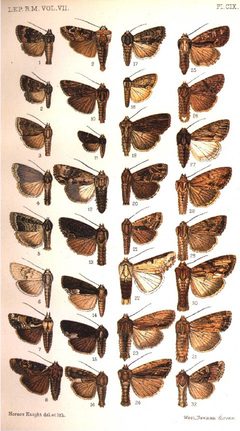
Wingspan measures 36–43 mm. As a member of the Apamea, possess cryptic forewing coloration typical of cutworm moths, with patterning that provides camouflage against bark or leaf litter substrates.
Habitat
Found in and temperate regions across eastern and central North America. Specific microhabitat preferences are poorly documented, but the likely occupies grassland, meadow, and open woodland edge consistent with its probable larval associations.
Distribution
Native to North America. Range extends from Saskatchewan, Manitoba, and Alberta in western Canada eastward to Newfoundland and Labrador, and southward through the eastern United States to North Carolina. Distribution records confirm presence in Alberta, Manitoba, Saskatchewan (Canada), and Vermont (United States).
Seasonality
are on wing from June to September, with timing varying by latitude and local climate conditions. The has one per year ().
Diet
Larvae probably feed on grasses and sedges (Poaceae and Cyperaceae). This dietary inference is based on documented feeding habits of related Apamea and associations, though direct observation of larval feeding for this specific species is limited.
Host Associations
- grasses - probable larval food plantPoaceae , inferred from -level patterns and source statement
- sedges - probable larval food plantCyperaceae , inferred from -level patterns and source statement
Life Cycle
One per year (). Larval stage presumably overwinters, with occurring in spring and in early summer. Specific details of , larval instars, and pupal stages are not well documented.
Behavior
are and attracted to artificial light sources. Typical of Noctuidae, adults likely hide in vegetation during daylight hours and become active after dusk. No specialized such as startle displays or acoustic signaling have been documented for this .
Ecological Role
Larvae function as herbivores, consuming grasses and sedges. serve as prey for including bats, birds, and predatory arthropods. The contributes to nutrient cycling as part of the following adult death.
Human Relevance
No significant documented economic impact. Occasionally encountered by entomologists and naturalists during surveys and at light stations. Not known as an agricultural pest. Contributes to biodiversity documentation and ecological monitoring efforts.
Similar Taxa
- Apamea amputatrixYellowheaded cutworm moth; congeneric with overlapping range and similar cryptic forewing patternation, requiring careful examination for separation
- Other Apamea species Apamea contains numerous morphologically similar ; A. verbascoides distinguished by combination of size, geographic range, and genitalia structure
More Details
Taxonomic history
Originally described as Xylophasia verbascoides by Guenée in 1852, later transferred to Apamea.
Observation data
iNaturalist records 506 observations, indicating moderate documentation level but with identification challenges potentially affecting data quality.