
Apamea quinteri
Mikkola & Lafontaine, 2009
Quinter's Cutworm Moth
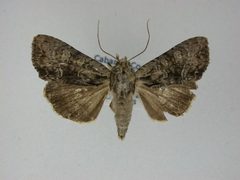
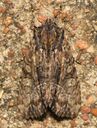
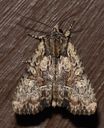
Apamea quinteri is a of cutworm moth in the Noctuidae, first described by Mikkola and Lafontaine in 2009. It belongs to a of notorious among lepidopterists for being difficult to identify due to individual variation and overlapping morphological features with . The species is known from North America. Like other Apamea species, it is and attracted to artificial light sources.
Pronunciation
How to pronounce Apamea quinteri: /əˈpeɪ.mi.ə ˈkwɪn.tɛr.i/
These audio files are automatically generated. While they are not always 100% accurate, they are a good starting point.
Identification
Members of the Apamea are notoriously difficult to distinguish from one another. Identification to level requires examination of genitalia or other specialized characteristics not reliably visible in field observations. The species was described in 2009, making it one of the more recently recognized species in a genus where taxonomic boundaries remain challenging.
Images
Distribution
North America. Specific range details beyond continental presence are not documented in available sources.
Behavior
. Attracted to artificial light sources, based on observations of at -lighting events.
Human Relevance
The MONA or Hodges number for this is 9329.1, used in North American identification systems. The species contributes to the documented diversity of the Noctuidae, one of the largest of Lepidoptera.
Similar Taxa
- Other Apamea speciesThe Apamea is explicitly noted as containing that are maddeningly difficult to identify due to individual variation and overlap in appearance. A. quinteri shares this general challenge with such as A. amputatrix (Yellowheaded ) and others.
More Details
Taxonomic recency
Described in 2009, this is a relatively recently recognized in a with ongoing taxonomic refinement.