
Apamea occidens
Grote, 1878
Western Apamea, Western Apamea Moth
Apamea occidens, commonly known as the Western Apamea or Western Apamea , is a noctuid moth native to western North America. The was first described by Augustus Radcliffe Grote in 1878. Its range extends from western regions eastward to Alberta and Kansas. Like other members of the Apamea, it belongs to a group of cutworm moths that can be challenging to identify due to individual variation and overlapping appearances with related species.
Pronunciation
How to pronounce Apamea occidens: //əˈpeɪ.mi.ə ˈɒk.sɪˌdɛnz//
These audio files are automatically generated. While they are not always 100% accurate, they are a good starting point.
Identification
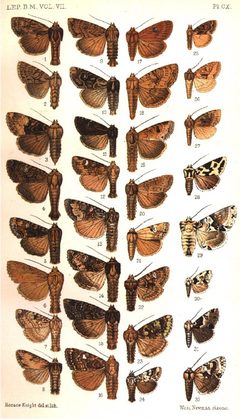
Members of the Apamea are notoriously difficult to identify due to substantial individual variation within and similar appearances across closely related . Specific diagnostic features for A. occidens distinguishing it from such as A. amputatrix are not clearly documented in available sources.
Images
Distribution
Native to western North America, with documented occurrence as far east as Alberta, Canada and Kansas, United States. GBIF records confirm presence in Alberta and Manitoba, Canada.
Similar Taxa
- Apamea amputatrixBoth belong to the challenging Apamea of cutworm moths; the source material explicitly notes difficulty in distinguishing between Apamea due to overlapping appearances and individual variation.