
Apamea burgessi ona
Smith, 1909
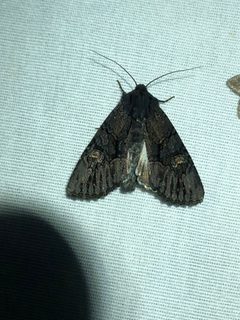
A of cutworm moth in the Noctuidae, distributed in the North American Great Plains. The nominate subspecies Apamea burgessi burgessi occurs in the eastern portion of the range, while A. burgessi ona occupies more western localities. Like other members of the Apamea, it is and attracted to light sources. The presents identification challenges due to individual variation and overlapping morphological traits with related .
Pronunciation
How to pronounce Apamea burgessi ona: /əˈpæmiə bɜrˈɡɛsaɪ ˈoʊnə/
These audio files are automatically generated. While they are not always 100% accurate, they are a good starting point.
Identification
Difficult to distinguish from other Apamea and due to substantial individual variation. The Apamea is noted as particularly challenging for identification because of overlapping appearances among species. Subspecies distinction from A. burgessi burgessi is based on geographic distribution rather than readily apparent morphological differences. Detailed examination of genitalia or molecular analysis may be required for definitive identification.
Images
Habitat
Associated with prairie and grassland . The type of environment suggests open landscapes with grasses and herbaceous vegetation.
Distribution
Recorded from the Canadian provinces of Alberta and Saskatchewan. Represents the western of Apamea burgessi, with the nominate subspecies occurring further east.
Behavior
; attracted to artificial light sources. This is consistent with observations of other Apamea at light stations during surveys.
Similar Taxa
- Apamea burgessi burgessiThe nominate , distinguished primarily by eastern geographic distribution; morphological separation is subtle and requires expert examination.
- Other Apamea speciesThe as a whole presents identification difficulties due to individual variation and convergent morphological traits among .
Sources and further reading
- BugGuide
- GBIF taxonomy match
- iNaturalist taxon
- Catalogue of Life
- Bug Eric: National Moth Week Recap for Colorado Springs
- Flora of Cameroon: Annonaceae Vol 45 available in print, as well as Open Access format with PhytoKeys | Blog
- ‘Hidden fish’ genus described for 2 new weakly electric mormyrid species from Gabon | Blog