
Schinia erosa
Smith, 1906
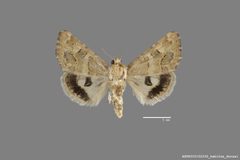
Schinia erosa is a noctuid described by Smith in 1906. It inhabits desert regions of the southwestern United States, specifically the Mojave and Sonoran Desert areas east of the Peninsular Range in southern California and south-central Arizona. The is with active in late summer and fall, and exhibits a specialized larval association with Isocoma acredenia (burrobrush), a desert shrub in the Asteraceae .
Pronunciation
How to pronounce Schinia erosa: /ˈskɪniə ɪˈroʊsə/
These audio files are automatically generated. While they are not always 100% accurate, they are a good starting point.
Images
Habitat
Arid desert environments, specifically the Mojave and Sonoran Desert regions. Associated with desert scrub vegetation dominated by its larval plant Isocoma acredenia.
Distribution
to southwestern North America. Documented from desert areas east of the Peninsular Range in southern California (including the Mojave Desert) and south-central Arizona.
Seasonality
are on wing from late summer to early November, with peak activity likely occurring in September and October.
Diet
Larvae feed exclusively on Isocoma acredenia (burrobrush), a desert shrub. feeding habits are not documented.
Host Associations
- Isocoma acredenia - larval Larvae feed on this desert shrub; the specific epithet 'acredenia' refers to this association
Life Cycle
Complete with , larval, pupal, and stages. Larval development occurs on Isocoma acredenia. likely occurs in soil. with one per year.
Ecological Role
As a herbivore, larvae contribute to nutrient cycling in desert through consumption of Isocoma acredenia. The is part of the noctuid guild that provides food resources for including bats and nocturnal birds.
Similar Taxa
- Schinia tertiaBelongs to the same 'tertia ' and shares similar desert distribution and ; distinguished by wing pattern and genitalic differences
- Other Schinia speciesThe Schinia contains numerous similar-appearing flower moths with specialized associations; accurate identification requires examination of genitalia and wing pattern details
More Details
Taxonomic History
Schinia erosa was described by Smith in 1906 and is part of the 'tertia ' within Schinia, a group of closely related that has undergone taxonomic revision. The species epithet 'erosa' refers to the eroded or worn appearance of wing markings.
Conservation Status
Not formally assessed. Given its restricted distribution in rapidly urbanizing southern California desert regions and specialized plant association, the may be vulnerable to loss, though no studies have been conducted.
Sources and further reading
- BugGuide
- Wikipedia
- GBIF taxonomy match
- iNaturalist taxon
- Catalogue of Life
- Meloidae Holdings | Entomology Research Museum
- Food for Thought and Food for the Monarchs | Bug Squad
- Year 2023: What Does the Year Hold for Monarchs and Tropical Milkweed? | Bug Squad
- Bug Spotlight | Entomology Research Museum
- Bohart Museum Open House: A Monarch State of Mind | Bug Squad
- Tropical Milkweed Doesn't Deserve the Bad Rap | Bug Squad