
Amphipyra tragopoginis
(Clerck, 1759)
Mouse Moth
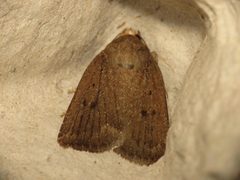
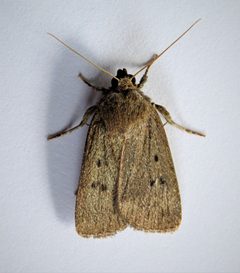
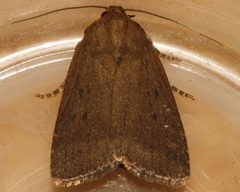
Amphipyra tragopoginis, the Mouse , is a widespread noctuid moth with a Holarctic distribution. The has undergone significant decline in the UK, dropping over 80% between 1970 and 2016. Its has been sequenced, revealing an 806 Mb assembly with 13,359 protein-coding genes. The species is notable for its unusual and attraction to sugary baits rather than light.
Pronunciation
How to pronounce Amphipyra tragopoginis: //ˌæm.fɪˈpaɪ.rə ˌtræɡ.oʊˈpɒɡ.ɪ.nɪs//
These audio files are automatically generated. While they are not always 100% accurate, they are a good starting point.
Identification
Distinguished from related Amphipyra by its characteristic : when disturbed, it typically scuttles away rather than taking flight immediately. are more reliably attracted to sugary baits than to light traps, which may cause under-recording in standard surveys. The species is a strong flyer capable of reaching heights of 12 meters.
Images
Habitat
Deciduous woodland; specimen for sequencing collected from Wytham Woods, Oxfordshire, UK. Inferred to occupy wooded and shrubby environments based on larval plant requirements and collection locality.
Distribution
Central and northern Europe, with scattered records from Asia. Introduced to United States and Canada. GBIF records confirm presence in Belgium (including Brussels-Capital, Flemish, and Walloon regions) and North America.
Seasonality
on the wing from July to September in the UK. Most active in early part of night just after darkness, with peak activity on warm nights up to 21°C.
Diet
Larvae are , feeding on leaves of a broad range of trees, shrubs, and herbaceous plants. attracted to sugary baits.
Life Cycle
Complete with , larva, pupa, and stages. Specific details of egg and pupal stages not documented in available sources.
Behavior
When disturbed, often scuttles away instead of flying. Flies primarily in early part of night just after darkness. Activity favored by warm nights up to 21°C. Strong flyer capable of reaching 12 meters height. More reliably attracted to sugary baits than to light, potentially causing under-recording in standard surveys.
Human Relevance
Subject of sequencing research with 806 Mb assembly published in Wellcome Open Research. trends monitored in UK, where it has declined over 80% from 1970 to 2016, indicating potential value as a biodiversity .
Similar Taxa
- Amphipyra pyramideaCongeneric in same ; both are noctuid with similar . A. pyramidea caterpillars have been documented as prey for eastern bluebirds, whereas A. tragopoginis is distinguished by its scuttling escape and stronger attraction to sugary baits.
More Details
Genome Assembly
sequenced from specimen collected Wytham Woods, UK. Assembly: 806 Mb scaffolded into 31 chromosomal pseudomolecules plus Z . 13,359 protein-coding genes identified. DOI: 10.12688/wellcomeopenres.18946.1
Population Trends
UK declined over 80% from 1970 to 2016 according to sources cited in paper (Randle et al. 2019).