
Acronicta oblinita
Smith, J.E., 1797
Smeared Dagger, Smeared Dagger Moth, Arioch Dagger, Smartweed Caterpillar (larva)
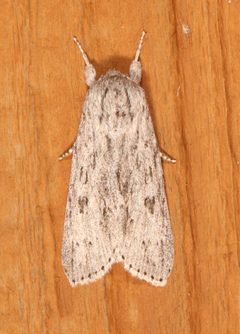
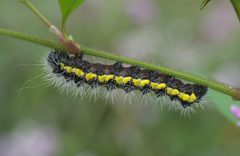
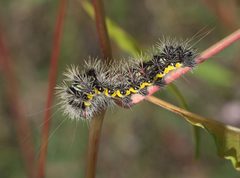
Acronicta oblinita is a noctuid native to North America, commonly known as the smeared dagger moth. display cryptic gray forewings with distinctive smeared dark wedge spots and white hindwings. The larva, called the smartweed caterpillar, bears and bright yellow caret-shaped markings. The was first described by James Edward Smith in 1797.
Pronunciation
How to pronounce Acronicta oblinita: /əˈkrəʊnɪktə ˌɒblɪˈnaɪtə/
These audio files are automatically generated. While they are not always 100% accurate, they are a good starting point.
Identification
distinguished from other Acronicta by smeared-appearing dark wedge spots on forewings with inward-pointing apices, combined with white hindwings. Larva identified by combination of tufts on wart-like and bright yellow caret-shaped markings between ; these features separate it from other dagger caterpillars.
Images
Habitat
Occupies bogs and coastal marshes in the Pacific Northwest, and wetlands, forests, and meadows more broadly across its range. Recorded from forests in Canada.
Distribution
Transcontinental in North America: across Canada from Nova Scotia to British Columbia, north to Lake Athabasca; in the United States, found in the Pacific Northwest and east of the Rocky Mountains south to Florida and Texas.
Seasonality
One to two per year. active early March through late June, and again mid-August to early October in coastal North Carolina. Overwinters as pupa.
Diet
Larva feeds on Salix (willows), Alnus (alders), Fragaria (strawberries), Typha (cattails), Chamaenerion angustifolium (fireweed), and Polygonum (knotweeds/smartweeds). diet unknown.
Life Cycle
Complete with one to two annually. Caterpillars may pupate within folded leaves of plant. stage is pupal.
Behavior
attracted to light. Caterpillars possess for defense.
Ecological Role
Larva functions as herbivore on diverse wetland and riparian plants. Serves as for (implied by general noctuid , though specific records for this not documented in sources).
Human Relevance
Larval may cause skin irritation upon contact. No significant economic impact documented.
Similar Taxa
- Acronicta americanaAmerican dagger moth has similar gray forewings but lacks smeared wedge spots; larva has longer, more prominent black hair tufts without yellow caret markings.
- Acronicta radcliffeiRadcliffe's dagger moth has more distinctly patterned forewings with clearer and spots; larval coloration differs.
- Acronicta betulaeBirch dagger moth has two-toned forewing appearance and more restricted eastern distribution; associated with birch .
More Details
Etymology
The specific epithet 'oblinita' and 'smeared dagger' refer to the smeared appearance of the dark wedge spots on the forewings.
Taxonomic history
Originally described as Phalaena oblinita by James Edward Smith in 1797, later transferred to Acronicta.