
Acronicta insularis
(Herrich-Schäffer, 1868)
cattail caterpillar, Henry's marsh moth
Acronicta insularis is a noctuid native to North America, with larvae known as the cattail caterpillar and as Henry's marsh moth. The was first described in 1868 and was reclassified from Simyra to Acronicta in 2015 based on phylogenetic analysis. It has a transcontinental distribution across the United States and southern Canada, with adults active from spring through late summer and larvae feeding on wetland plants including cattails and various grasses.
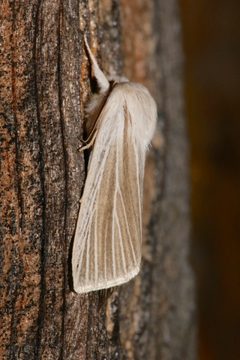
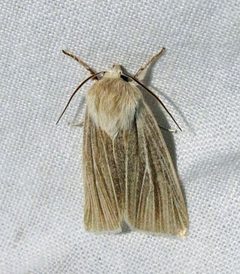
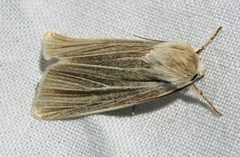
Pronunciation
How to pronounce Acronicta insularis: //ˌækrəˈnɪktə ˌɪnsəˈlɛrɪs//
These audio files are automatically generated. While they are not always 100% accurate, they are a good starting point.
Identification
The can be distinguished from similar Acronicta species by its association with wetland and larval plants. are active during a prolonged season (April–September) compared to some . The former placement in Simyra was revised based on molecular , and the species now groups with other Acronicta based on shared derived characters. The MONA/Hodges number 9280 provides a standardized reference for North American lepidopterists.
Images
Habitat
Wetland and marsh environments, including areas supporting stands of Typha (cattails), Polygonum , and various grasses and sedges. The species is also associated with riparian zones where poplar and willow occur.
Distribution
Transcontinental across North America: found throughout the United States from coast to coast and in southern Canada including Ontario, Quebec, New Brunswick, Nova Scotia, British Columbia, Alberta, Saskatchewan, and Manitoba.
Seasonality
are on wing from April to September, indicating a multivoltine or continuously brooded across its range with peak activity during warmer months.
Diet
Larvae feed on Typha (cattails), Polygonum species, various grasses and sedges, poplar (Populus), and willow (Salix). feeding habits are not documented in available sources.
Host Associations
- Typha - larval food plantcattails
- Polygonum - larval food plantknotweeds and related
- Populus - larval food plantpoplar
- Salix - larval food plantwillow
Life Cycle
Complete with , larva, pupa, and stages. The larval stage is known as the cattail caterpillar. Specific details of site, stage, and number of per year are not documented in available sources, though the extended adult period suggests multiple generations.
Behavior
Larvae are associated with feeding on emergent wetland vegetation. are and attracted to light. Specific behavioral details regarding mating, oviposition, or larval habits are not documented in available sources.
Ecological Role
Larval herbivory on wetland plants contributes to nutrient cycling in marsh . The serves as a food source for and , though specific trophic interactions are not documented. As a widely distributed feeder on common wetland plants, it likely plays a role in wetland dynamics.
Human Relevance
The has no documented economic importance. It may serve as an indicator of wetland quality due to its dependence on specific marsh plants. The distinctive for larval and stages reflect traditional natural history knowledge of the species in North America.
Similar Taxa
- Acronicta species formerly placed in SimyraA. insularis was transferred from Simyra to Acronicta in 2015 along with from Oxicesta and Eogena; these share the historical taxonomic confusion and phylogenetic affinity
- Other wetland-associated Noctuidae in such as Phragmatophilinae or certain Amphipyrinae that share marsh and larval associations with Typha may occur sympatrically
Misconceptions
The was long classified under the Simyra based on morphological similarity, but molecular phylogenetic analysis demonstrated that Simyra, Oxicesta, and Eogena are nested within Acronicta, leading to their synonymy under Acronicta in 2015. The 'cattail caterpillar' applies specifically to the larva, while 'Henry's marsh ' refers to the stage.
More Details
Taxonomic History
Originally described as Tapinostola insularis by Herrich-Schäffer in 1868, later treated as Simyra insularis, and finally transferred to Acronicta in 2015 based on phylogenetic analysis by Schmidt et al. The has two recognized : A. i. insularis and A. i. julitae.
Nomenclatural Reference
The MONA ( of North America) or Hodges number for this is 9280, providing a stable identifier independent of taxonomic changes.