
Acronicta cyanescens
Hampson, 1909
Blue-gray Dagger
Acronicta cyanescens is a medium-sized noctuid of western North America, commonly known as the Blue-gray Dagger. First described by George Hampson in 1909, this is distinguished by its blue-gray coloration and dagger-like markings. are active during summer months, with a single per year. The species belongs to a whose caterpillars are often called 'dagger moths' due to their distinctive projections.
Pronunciation
How to pronounce Acronicta cyanescens: /ˌæ.krəˈnɪk.tə ˌsaɪ.əˈnɛ.skənz/
These audio files are automatically generated. While they are not always 100% accurate, they are a good starting point.
Identification
The blue-gray coloration distinguishes A. cyanescens from the more boldly patterned Acronicta americana (American Dagger Moth), which has yellowish to whitish forewings with black markings. It can be separated from other western Acronicta by its specific shade of blue-gray and the configuration of the dark streaks on the forewings. Examination of genitalia may be necessary for definitive identification where ranges overlap with similar species.
Images
Appearance
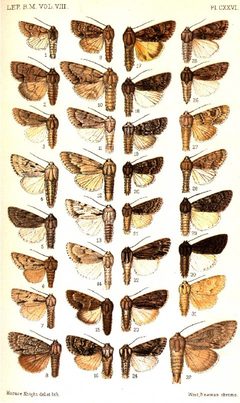
have a wingspan of 45–47 mm. The forewings are blue-gray with darker markings, including the characteristic 'dagger' streaks typical of the . The overall coloration is muted compared to some related , with subtle patterning that provides camouflage against bark and rock surfaces.
Habitat
Found in varied environments across western North America, including montane forests, riparian corridors, and scrubland transitions. The appears to favor areas with adequate moisture and woody vegetation that supports larval plants.
Distribution
Western North America, from extreme southwestern Alberta westward through the Rocky Mountains and Great Basin, south to New Mexico. The range encompasses the mountainous and intermountain regions of the western United States and adjacent Canada.
Seasonality
are on wing from June to July. The has one per year (), with exact timing varying by elevation and latitude.
Life Cycle
Complete with , larva, pupa, and stages. Larval plants are not documented in available sources. likely occurs in soil or leaf litter. One per year.
Behavior
are and attracted to light. Like other members of the , they are presumably strong fliers capable of dispersing across suitable patches.
Ecological Role
As larvae, likely function as herbivores on woody plants; specific associations undocumented. may serve as prey for including bats and night-foraging birds.
Human Relevance
No documented economic importance. Occasionally encountered by enthusiasts and researchers conducting insect surveys. Not known to be a pest .
Similar Taxa
- Acronicta americanaLarger size, yellowish to whitish forewings with bold black markings rather than blue-gray coloration; eastern North American distribution with limited western overlap
- Acronicta betulaeBirch Dagger Moth has more contrasting pattern with two-toned forewing appearance; primarily eastern in distribution
- Acronicta radcliffeiRadcliffe's Dagger Moth has different forewing pattern and coloration; found in eastern deciduous forests
More Details
Taxonomic Note
The was originally described as Acronycta cyanescens by Hampson in 1909, with the later amended to Acronicta. Some sources list this species as a synonym of Acronicta lepusculina, though GBIF and other contemporary databases treat A. cyanescens as a valid accepted species.
Etymology
The specific epithet 'cyanescens' refers to the blue-gray (cyan) coloration of the .
Sources and further reading
- BugGuide
- Wikipedia
- GBIF taxonomy match
- iNaturalist taxon
- NCBI Taxonomy
- Catalogue of Life
- Agrilus fuscipennis on Persimmon | Beetles In The Bush
- Megalopygidae | Beetles In The Bush
- Bug Eric: New Mexico Dragonfly Blitz - Day 4
- Bug Eric: Remembering Moth Week 2025
- Bug Eric: First Night of Blacklighting
- Bug Eric: April 2024