
Paectes
Hübner, 1818
Species Guides
10- Paectes abrostolella(Barrens Paectes Moth)
- Paectes abrostoloides(Large Paectes Moth)
- Paectes acutangula
- Paectes asper
- Paectes declinata
- Paectes fuscescens
- Paectes nana
- Paectes nubifera(Clouded Paectes Moth)
- Paectes oculatrix(Eyed Paectes Moth)
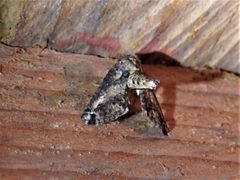
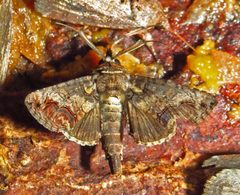
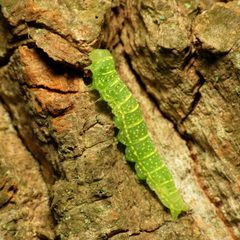
Paectes is a of in the Euteliidae, established by Jacob Hübner in 1818. The genus contains approximately 20 described distributed across the Americas and Asia. Several species have been investigated as potential agents for plants, particularly for Brazilian peppertree (Schinus terebinthifolia) in Florida. Species in this genus are characterized by distinctive morphological features including upturned palpi, tufted abdominal segments, and specific wing margin shapes. Cryptic exist within the genus, with species often distinguishable only by genitalia characters rather than wing patterns.
Pronunciation
How to pronounce Paectes: /ˈpæk.tiːz/
These audio files are automatically generated. While they are not always 100% accurate, they are a good starting point.
Identification
Identification to level requires examination of male and female genitalia, as wing patterns are often similar among closely related species and can be misleading. The Paectes arcigera exemplifies this cryptic diversity, where multiple species share nearly identical wing patterns but differ substantially in reproductive . Within the complex, dissection of genital characters is necessary for accurate determination. The can be distinguished from other Euteliidae by the combination of upturned palpi, abdominal tufting, and forewing margin shape. Species-level identification should reference original descriptions and revisionary works, particularly Pogue (2013) for the arcigera complex.
Images
Distribution
occur in North America, Central America, South America, and Asia. Specific distribution varies by species: North American records include Vermont and Colorado; Neotropical species documented from Brazil, Argentina, Venezuela, and the Dominican Republic; Asian species recorded from India (Madhya Pradesh).
Human Relevance
Several have been investigated as agents for plants. Paectes longiformis was evaluated for control of Brazilian peppertree (Schinus terebinthifolia) in Florida but rejected due to non-target effects on related species including native Rhus aromatica. Paectes subapicalis is a documented defoliator of Sal (Shorea robusta) in India, with potential to cause defoliation during . The discovery of cryptic species within the has implications for accurate identification in biocontrol research.
Similar Taxa
- EuteliaShares Euteliidae and Euteliinae; both have upturned palpi and similar overall body plan. Distinguished by specific wing margin characters and abdominal tufting patterns in Paectes.
- Other Euteliinae generaAll share the characteristics; Paectes distinguished by the combination of forewing with rectangular apex, obliquely curved outer margin, and lobed inner margin near base, plus the prominent anal tubular tuft in males.
More Details
Cryptic species diversity
The contains notable cryptic where multiple are morphologically similar in external appearance but reproductively isolated, as demonstrated by the Paectes arcigera complex. This has significant implications for and research, where accurate species identification is essential.
Taxonomic history
Originally placed in Noctuidae by some sources, now classified in Euteliidae, Euteliinae based on morphological and molecular evidence. The authority is sometimes cited as Hübner, 1806 or Hübner, 1818 depending on source.
Sources and further reading
- BugGuide
- Wikipedia
- GBIF taxonomy match
- iNaturalist taxon
- NCBI Taxonomy
- Catalogue of Life
- Bug Eric: National Moth Week Recap for Colorado Springs
- Uncategorized | Blog - Part 42
- Biocontrol research on Brazilian peppertree in Florida discovers new cryptic species | Blog
- A note on Paectes subapicalis Walker (Lepidoptera: Noctuidae): A potential Sal defoliator in Madhya Pradesh
- Host range tests reveal Paectes longiformis is not a suitable biological control agent for the invasive plant Schinus terebinthifolia
- Life history and host range determination of Paectes n. sp. – a potential classical biological control agent of Brazilian peppertree in the United States
- Description and biology ofPaectes longiformis(Lepidoptera: Euteliidae), a new species from Brazil and potential biological control agent of Brazilian peppertree in Florida