
Paectes acutangula
Hampson, 1912
Paectes acutangula is a in the Euteliidae, first described by Hampson in 1912. It is found in North America and has been assigned MONA/Hodges number 8964. The Paectes contains species that are frequently difficult to distinguish based on external alone, with genitalic characters often required for accurate identification. This species belongs to a group of moths whose wing patterns can be similar among closely related .
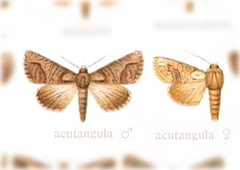

Pronunciation
How to pronounce Paectes acutangula: /ˈpaɪktɛs ˌækyˈtæŋgjʊlə/
These audio files are automatically generated. While they are not always 100% accurate, they are a good starting point.
Identification
in the Paectes, including P. acutangula, often require examination of male and female genitalic structures for definitive identification, as wing patterns among related species can be deceptively similar. The MONA/Hodges number 8964 provides a reference for North American records. External alone is generally insufficient to distinguish P. acutangula from without dissection and comparison of reproductive characters.
Images
Distribution
North America
Similar Taxa
- Paectes arcigera species complexMembers of this complex, including P. arcigera and related , share similar wing patterns with P. acutangula but differ in genitalic . The discovery of multiple cryptic species within this complex demonstrates that external appearance is unreliable for distinguishing among Paectes species without examination of internal reproductive structures.
More Details
Taxonomic Status
Catalogue of Life lists Paectes acutangula as a synonym, while GBIF and NCBI recognize it as an accepted . This discrepancy reflects ongoing taxonomic evaluation within the .
Observation Records
iNaturalist records only 2 observations of this , indicating it is either genuinely rare, underreported, or difficult to identify in the field.