
Leucoma salicis
(Linnaeus, 1758)
White Satin Moth, Satin Moth
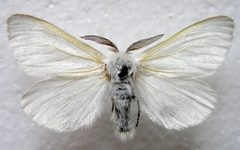
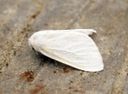
Leucoma salicis is a medium-sized native to the Palearctic, introduced to North America in the 1920s where it became an pest. are distinguished by pure white wings with a silky sheen, held tent-like over the body, contrasting with striking black-and-white banded legs. Larvae feed on Salix and Populus and can cause severe defoliation damage. The species is in most of its range, with adults active in June through August.
Pronunciation
How to pronounce Leucoma salicis: /luːˈkoʊmə ˈsælɪsɪs/
These audio files are automatically generated. While they are not always 100% accurate, they are a good starting point.
Identification
distinguished from similar white by combination of pure white wings with silky satin sheen, black and collar, and conspicuous zebra-striped black-and-white legs. Distinguished from East Asian Leucoma candida by larger size, less densely scaled wings, and different male genitalia structure. Black-spotted forms occur but are variable.
Images
Habitat
Damp locations including forest edges, hedgerows, riverine woodlands, and urban environments such as parks, gardens, and alleys with trees. In North America, found in hybrid poplar windbreak stands and ornamental street plantings.
Distribution
Native across Palearctic from Portugal and France west to Japan east, including most of Europe (excluding far north), Russia, Mongolia, Korea, China, and Japan. In Britain: south-eastern, central and north-western England, scattered Wales and Scotland, Isle of Man, and Ireland. Introduced to North America in 1920s; established in eastern Canada, north-eastern United States, and west coast from British Columbia to Oregon, California, and Idaho.
Seasonality
active June through August in most of range. in Britain, Canada, and most of range; some Hungarian . Males begin flying shortly before dusk.
Diet
Larvae feed on leaves of Salix (willow/sallow) and Populus (poplar/aspen) , including eastern cottonwood (Populus deltoides), trembling aspen, and black cottonwood. Less commonly recorded on Quercus (oak).
Host Associations
- Salix sp. - larval food plantprimary
- Populus sp. - larval food plantprimary , including P. deltoides
- Leucoma salicis nucleopolyhedrovirus (LesaNPV) - natural enemy/ with potential as agent
Life Cycle
laid in clusters of 150–200 on tree trunks and branches, covered with paper-like substance. Larvae hatch in autumn, feed briefly, then overwinter. Feeding resumes in spring. occurs in loose cocoon spun between leaves. Some .
Behavior
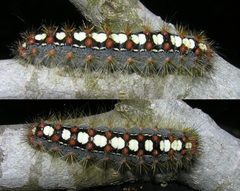
rest with wings held tent-like over body, displaying contrasting leg pattern. Males initiate shortly before dusk. Larvae are gregarious defoliators capable of stripping trees. Attacks healthy trees as primary pest rather than colonizing stressed hosts.
Ecological Role
Significant defoliator of Salicaceae in native and introduced ranges. In North America, causes serious damage to hybrid poplar plantations, trembling aspen, and black cottonwood. Subject to by parasitic Hymenoptera and Diptera, Bacillus thuringiensis var. kurstaki, and -based .
Human Relevance
pest in North America since 1920s introduction, causing economic damage to poplar plantations and ornamental trees. Managed through including agents. sequenced (733.2 Mb assembly) as part of biodiversity initiatives. Female identified as (3Z)-cis-6,7-cis-9,10-diepoxy-3-henicosene ('leucomalure').
Similar Taxa
- Leucoma candidaEast Asian with purer white, more thickly scaled opaque wings; smaller size with narrower wings; different male genitalia structure
- Other white Erebidae (e.g., Spilosoma, Hyphantria)Lack black-and-white banded legs and black /collar; different wing posture and sheen