
Caenurgina erechtea
(Cramer, 1780)
Forage Looper, Common Grass Moth
Caenurgina erechtea, commonly known as the Forage Looper or Common , is a widespread in the Erebidae. First described by Pieter Cramer in 1780, it occurs across the continental United States and adjacent Canadian provinces. are active from March through November, with timing varying by location. The species is frequently encountered in lawns and grassy areas, where through vegetation readily flushes individuals during daylight hours.
Pronunciation
How to pronounce Caenurgina erechtea: /ˌsiːnɚˈdʒaɪnə ɪˈrɛkθiə/
These audio files are automatically generated. While they are not always 100% accurate, they are a good starting point.
Identification
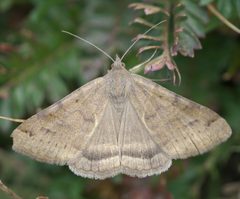
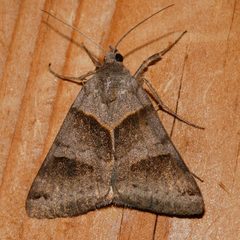
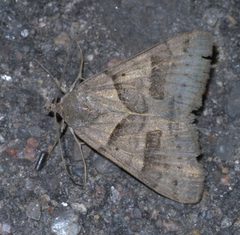
Distinguished from similar loopers (Caenurgina spp.) by the combination of gray-brown forewing coloration with relatively indistinct patterning and the pale hindwing. The lacks the more contrasting markings seen in some related Erebidae. flushed from lawns during daytime are characteristic. Final identification may require examination of genitalia or reference to regional keys.
Images
Appearance
Wingspan measures 30–42 mm. Forewings are typically gray-brown with variable patterning that often includes darker transverse lines and a small discal spot. Hindwings are paler, usually whitish or pale gray. The overall coloration provides effective camouflage against dead grasses and soil. Body is moderately robust with a furry .
Habitat
Occurs in open grassy environments including lawns, meadows, pastures, and agricultural fields. Strongly associated with herbaceous vegetation, particularly areas with clover, alfalfa, and grasses. Also found in disturbed and urban settings with maintained turf.
Distribution
Present from coast to coast across the continental United States. In Canada, recorded from Alberta, Manitoba, and Saskatchewan, with adjacent provincial records. Absent from Newfoundland, New Brunswick, Prince Edward Island, Yukon, and Northwest Territories.
Seasonality
are on wing from March to November, with peak activity timing varying by latitude and local climate conditions. Multiple occur annually in warmer regions.
Diet
Larvae feed on Ambrosia trifida (giant ragweed), various Trifolium (clover), grasses (Poaceae), and Medicago sativa (alfalfa). do not feed.
Host Associations
- Ambrosia trifida - larval food plant
- Trifolium - larval food plantvarious
- Poaceae - larval food plantvarious grass
- Medicago sativa - larval food plantalfalfa
Life Cycle
Complete with , larva, pupa, and stages. Larvae are loopers (inchworms) with reduced , moving with characteristic looping gait. occurs in soil or leaf litter. Multiple per year in most of range.
Behavior
are readily flushed from vegetation during daylight hours when disturbed, particularly from unmowed lawns. activity includes attraction to artificial light sources. is low and erratic when disturbed from daytime resting positions.
Ecological Role
Larvae function as herbivores in grassland and agricultural , consuming living plant tissue. serve as prey for birds, bats, and other . The contributes to nutrient cycling through larval feeding and subsequent decomposition.
Human Relevance
Occasional minor pest in alfalfa and clover crops, though rarely reaching economically damaging levels. Frequently encountered by homeowners in lawns, where it is often noticed only when flushed during yard work. Serves as an accessible for citizen science observation and monitoring programs.
Similar Taxa
- Caenurgina crassiusculaSimilar size and general appearance, but typically shows more contrasting forewing pattern with darker markings; ranges overlap broadly
- Other Erebidae loopersShare looping larval locomotion and general ; require detailed examination for separation
More Details
Taxonomic Note
Originally described as Phalaena erechtea by Cramer in 1780; later transferred to Caenurgina. The is the type species of the genus Caenurgina.
Abundance
Described as abundant throughout its range, particularly in the central United States. One of the most commonly encountered in blacklight surveys and daytime lawn sampling.