
Catocala unijuga
Walker, 1858
once-married underwing, once-married underwing moth
Catocala unijuga is a large underwing in the Erebidae, first described by Francis Walker in 1858. are characterized by cryptic forewings that conceal brightly patterned hindwings, a trait shared across the Catocala. The is distributed across northern and western North America, with larvae feeding on poplars and willows. Adults fly from July to September in a single .
Pronunciation
How to pronounce Catocala unijuga: //ˌkætoʊˈkeɪlə ˌjuːnɪˈdʒuːɡə//
These audio files are automatically generated. While they are not always 100% accurate, they are a good starting point.
Identification
Distinguished from other Catocala by specific forewing pattern elements and hindwing coloration; precise identification requires reference to diagnostic markings on the forewing and the color pattern of the exposed hindwing. The species name "unijuga" (Latin: "once-married" or "single-yoked") may refer to a specific marking. Separation from similar species such as Catocala concumbens or C. ilia requires careful examination of wing patterns and, in some cases, genitalic dissection.
Images
Appearance
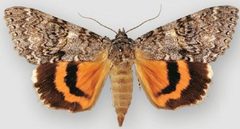
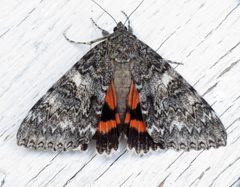
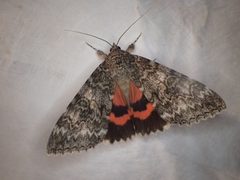
Wingspan 68–82 mm. Forewings gray-brown with cryptic patterning that blends with tree bark. Hindwings display bold patterning typical of underwing moths, with distinct coloration visible when wings are spread at rest or in . simple, not strongly feathered. Body robust, typical of large noctuid-like .
Habitat
Associated with riparian and woodland where larval plants occur. Found in mixed forests, aspen groves, and areas with poplar and willow stands. In western portions of range, occurs in montane and submontane zones including dry mixed conifer forest with oaks.
Distribution
North America: Newfoundland west to south-central British Columbia, south to Kentucky and Missouri in the east, and to Colorado and Utah in the west. Present in Canadian provinces including Alberta, Manitoba, and Saskatchewan.
Seasonality
active July to September. Single per year (), with timing varying by location and elevation.
Diet
Larvae feed on Populus tremuloides (quaking aspen), Populus nigra (black poplar), and Salix (willows). feeding habits not documented in sources.
Life Cycle
Complete with , larva, pupa, and stages. Single ; larvae feed on foliage, presumably occurs in soil or leaf litter. Specific details of pupal stage and stage not documented in sources.
Behavior
are and attracted to light, though underwing moths in the Catocala typically remain on the periphery of light stations or may be flushed from nearby vegetation rather than landing directly on light sheets. When disturbed, adults flash brightly colored hindwings as a startle defense before taking .
Ecological Role
Larval stage functions as a folivore on poplar and willow , contributing to nutrient cycling in riparian and forest . serve as prey for including bats and birds; larvae are prey for and .
Human Relevance
Subject of interest to lepidopterists and citizen scientists; are sought after by enthusiasts for their striking hindwing patterns. Featured in National Moth Week events and other citizen science biodiversity documentation efforts. No documented economic importance as pest or beneficial .
Similar Taxa
- Catocala concumbensSimilar size and general appearance; distinguished by differences in forewing pattern and hindwing coloration
- Catocala iliaOverlaps in range and ; requires examination of specific wing markings for separation
- Other Catocala species members share cryptic forewings and colorful hindwings; precise identification relies on pattern details and often requires genitalic examination
Sources and further reading
- BugGuide
- Wikipedia
- GBIF taxonomy match
- iNaturalist taxon
- NCBI Taxonomy
- Catalogue of Life
- A Gathering of Lepidopterists: Who's Who of the Butterfly, Moth Experts | Bug Squad
- Got Moths? Celebrate National Moth Week and Global Citizen Science
- Bug Eric: National Moth Week Recap, 2015
- Bug Eric: National Moth Week Recap for Colorado Springs
- Bug Eric: National Moth Week 2024 Recap from Kansas City
- Bug Eric: New Mexico Night Bugs