
Catocala robinsonii
Grote, 1872
Robinson's Underwing
Robinson's Underwing (Catocala robinsonii) is a medium-sized underwing in the Erebidae, first described by Augustus Radcliffe Grote in 1872. The is characterized by cryptic forewings that conceal brightly patterned hindwings, a defensive trait common to the Catocala. It occurs primarily in eastern and central North America, with larvae specializing on hardwood trees including hickory, walnut, and oak.
Pronunciation
How to pronounce Catocala robinsonii: /ˌkætəˈkeɪlə ˌrɒbɪnˈsəni/
These audio files are automatically generated. While they are not always 100% accurate, they are a good starting point.
Identification
Distinguished from other Catocala by specific forewing pattern elements and hindwing coloration details. The combination of geographic range and larval plant association (Carya, Juglans, Quercus) supports identification. Examination of genitalia may be required for definitive separation from similar sympatric species.
Images
Appearance
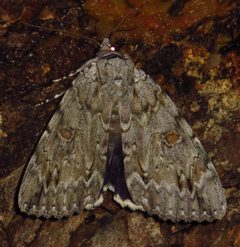
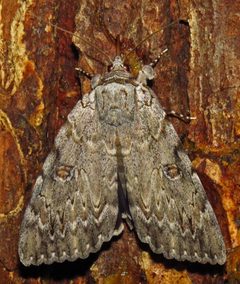
have a wingspan of 70–80 mm. Forewings are gray-brown with intricate dark patterning, serving as bark-like camouflage when at rest. Hindwings are concealed at rest but display bold coloration when exposed—typically featuring bands of orange, red, or yellow with dark markings. The body is robust and densely scaled.
Habitat
Deciduous and mixed hardwood forests; areas where larval trees (hickory, walnut, oak) are present. are sometimes attracted to light sources at night, though underwing moths typically remain on the periphery of lighted areas rather than landing directly on sheets.
Distribution
Eastern and central North America: southern Ontario and New Hampshire south to Florida, west to Oklahoma, Missouri, and Arkansas, northward through Illinois, Indiana, and Michigan (rare in Michigan).
Seasonality
are active from July to October, with timing varying by location. One per year is likely.
Diet
Larvae feed on Carya ovata (shagbark hickory), Juglans (walnut), and Quercus alba (white oak). feeding habits are not documented.
Host Associations
- Carya ovata - larval food plantshagbark hickory
- Juglans - larval food plantwalnut
- Quercus alba - larval food plantwhite oak
Life Cycle
One per year. Larvae feed on tree foliage. occurs in soil or leaf litter. emerge in mid-summer to autumn.
Behavior
are . When disturbed, they flash their brightly colored hindwings to startle before taking —a characteristic defensive of the Catocala. They typically do not come directly to light traps, instead remaining at the periphery of illuminated areas or being flushed from daytime resting sites on tree trunks.
Ecological Role
Larvae function as folivores on hardwood trees, contributing to nutrient cycling in forest . may serve as prey for bats, birds, and other ; their startling display may reduce pressure.
Human Relevance
Subject of interest to lepidopterists and citizen scientists, particularly during National Week events. Not known to be of economic importance.
Similar Taxa
- Catocala concumbensSympatric underwing with similar size and ; distinguished by forewing pattern and hindwing coloration details
- Catocala epioneAnother eastern North American underwing; overlapping range but differing in forewing markings and hindwing band pattern
Sources and further reading
- BugGuide
- Wikipedia
- iNaturalist taxon
- A Gathering of Lepidopterists: Who's Who of the Butterfly, Moth Experts | Bug Squad
- Got Moths? Celebrate National Moth Week and Global Citizen Science
- Bug Eric: National Moth Week Recap, 2015
- Bug Eric: National Moth Week Recap for Colorado Springs
- Bug Eric: National Moth Week 2024 Recap from Kansas City
- Bug Eric: New Mexico Night Bugs