
Catocala residua
Grote, 1874
Residua Underwing
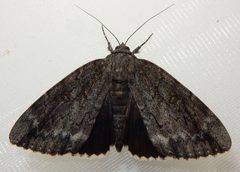
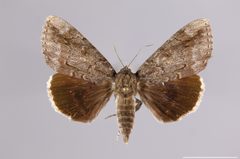
Catocala residua is a North American underwing in the Erebidae, first described by Augustus Radcliffe Grote in 1874. are medium-sized with a wingspan of 60–73 mm and are active from July to September. The is distinguished by its cryptic forewings and brightly patterned hindwings characteristic of the Catocala.
Pronunciation
How to pronounce Catocala residua: /ˌkætəˈkeɪlə rɪˈsɪdʒuə/
These audio files are automatically generated. While they are not always 100% accurate, they are a good starting point.
Identification
Identified as a member of Catocala by the underwing posture and concealed colorful hindwings. Specific identification within the genus requires examination of forewing pattern details and hindwing coloration and markings. Differentiation from similar Catocala relies on subtle differences in wing patterns and geographic distribution.
Images
Appearance
Wingspan 60–73 mm. Forewings are dull-colored, providing camouflage when at rest. Hindwings display bold, colorful patterns typical of underwing moths, concealed beneath the forewings when the is not in .
Habitat
Associated with woodland and forested where plants of the Carya occur. Found in areas supporting hickory .
Distribution
Eastern North America: southern Ontario, Quebec, and Maine south to North Carolina and Georgia, west to Mississippi and Missouri, and north to Iowa, Illinois, and Michigan.
Seasonality
on wing from July to September, with exact timing varying by location.
Diet
Larvae feed on Carya : Carya glabra (pignut hickory), Carya illinoinensis (pecan), Carya laciniosa (shellbark hickory), and Carya ovata (shagbark hickory). diet not documented.
Host Associations
- Carya glabra - larval plantpignut hickory
- Carya illinoinensis - larval plantpecan
- Carya laciniosa - larval plantshellbark hickory
- Carya ovata - larval plantshagbark hickory
Behavior
are and attracted to light. Like other underwing moths, adults may exhibit a startle defense response by flashing their brightly colored hindwings when disturbed, then taking .
Ecological Role
Larvae function as herbivores on hickory trees. may serve as prey for and as potential , though specific ecological roles are not well documented.
Human Relevance
Subject of interest to lepidopterists and enthusiasts, particularly during National Moth Week events. No documented economic importance or pest status.
Similar Taxa
- Other Catocala speciesShare the characteristic underwing with cryptic forewings and colorful hindwings; require detailed examination of wing patterns and geographic range for differentiation
More Details
Etymology
The specific epithet 'residua' and 'Residua Underwing' refer to the ' characteristics, though the precise meaning of 'residua' in this context is not documented in available sources.
Sources and further reading
- BugGuide
- Wikipedia
- GBIF taxonomy match
- iNaturalist taxon
- NCBI Taxonomy
- Catalogue of Life
- A Gathering of Lepidopterists: Who's Who of the Butterfly, Moth Experts | Bug Squad
- Consumer-Grade Insecticide Sprays Fail to Control Cockroaches, Study Shows
- Got Moths? Celebrate National Moth Week and Global Citizen Science
- Bug Eric: National Moth Week Recap, 2015
- Bug Eric: National Moth Week Recap for Colorado Springs
- Bug Eric: National Moth Week 2024 Recap from Kansas City