
Catocala meskei
Grote, 1873
Meske's Underwing, Meske's Underwing Moth
Catocala meskei is a large underwing in the Erebidae, first described by Augustus Radcliffe Grote in 1873. Like other members of the Catocala, it exhibits the characteristic underwing pattern: cryptic, bark-mimicking forewings that conceal brightly colored hindwings. The has a transcontinental North American distribution spanning from the Atlantic coast to the Rocky Mountains. are active during mid to late summer, and larvae feed on poplar and willow species.

Pronunciation
How to pronounce Catocala meskei: //kætoʊˈkɑːlə ˈmɛskeɪ//
These audio files are automatically generated. While they are not always 100% accurate, they are a good starting point.
Identification
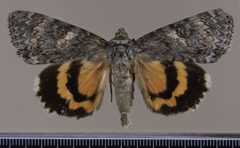
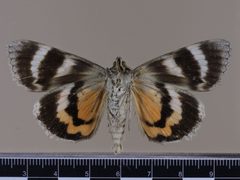
As a Catocala , C. meskei is identified by the underwing : cryptic forewings hiding brightly patterned hindwings. Specific identification requires examination of forewing pattern details, hindwing coloration and banding, and often genitalic dissection. The species is most reliably distinguished from similar underwings by geographic range and association with Populus-Salix plants. C. meskei orion, described from Alberta, is now synonymized and not considered valid.
Images
Appearance
have a wingspan of 65–75 mm. The forewings are typically dull gray-brown with intricate dark patterning that provides camouflage against tree bark. The hindwings, concealed at rest, display bold coloration characteristic of underwing moths—likely including bands of orange, red, or black (specific hindwing pattern not detailed in sources). The body is robust and furry, typical of large noctuidoid . , if present, is not documented in available sources.
Habitat
Associated with riparian and woodland where plants (Populus and Salix ) occur. Found in mixed forests, woodlands, and areas with cottonwoods, poplars, and willows. Elevation range includes at least 7,000 feet in southwestern mountains.
Distribution
Transcontinental in North America: from Maine and Quebec west to southern Alberta and Montana; south to South Carolina in the east and at least to Montana in the west. Canadian records include Alberta, Manitoba, and Saskatchewan.
Seasonality
are on wing from July to September, with exact timing varying by location. Single-brooded (), with period concentrated in mid to late summer.
Diet
Larvae feed on Populus (poplars, cottonwoods) and Salix (willows) . feeding habits not documented.
Host Associations
- Populus - larval food plantpoplars, cottonwoods
- Salix - larval food plantwillows
Life Cycle
Complete with , larva, pupa, and stages. Larvae are external feeders on plant foliage. likely occurs in soil or leaf litter, though specific details not documented. Adults emerge in summer.
Behavior
are and attracted to light, though underwing moths typically remain on the periphery of light stations rather than landing directly on sheets. Adults may also be attracted to fermenting (sugaring). When disturbed, adults flash their brightly colored hindwings as a startle defense against , then fly to conceal themselves on tree bark with forewings covering the hindwings.
Ecological Role
Larvae function as herbivores on riparian trees, contributing to nutrient cycling and serving as prey for and . serve as prey for predators including bats, birds, and spiders. The startle display may indicate aposematic or deimatic defensive function.
Human Relevance
Subject of citizen science observation during National Week and similar events. Collected by lepidopterists; specimens documented in entomological museums including University of Alberta Strickland Museum. No documented economic importance.
Similar Taxa
- Catocala aholibahAnother large underwing with overlapping western range; distinguished by specific forewing and hindwing pattern differences
- Catocala verillianaSmaller underwing found in similar ; overlaps in range and season
- Catocala epioneEpione Underwing with overlapping range; distinguished by hindwing pattern and forewing markings
More Details
Taxonomic History
The Catocala meskei orion, described from Alberta, has been synonymized with the nominate form and is no longer recognized as valid.
Etymology
The specific epithet meskei honors an individual (likely a collector or colleague of Grote), though the exact namesake is not documented in available sources. The follows standard underwing naming conventions.
Research Status
Basic information remains incompletely documented; larval and details would benefit from further study. The is represented in museum collections but is not among the most frequently encountered Catocala species in general surveys.
Sources and further reading
- BugGuide
- Wikipedia
- GBIF taxonomy match
- iNaturalist taxon
- NCBI Taxonomy
- Catalogue of Life
- A Gathering of Lepidopterists: Who's Who of the Butterfly, Moth Experts | Bug Squad
- Got Moths? Celebrate National Moth Week and Global Citizen Science
- Bug Eric: National Moth Week Recap, 2015
- Bug Eric: National Moth Week Recap for Colorado Springs
- Bug Eric: National Moth Week 2024 Recap from Kansas City
- Bug Eric: New Mexico Night Bugs