
Catocala junctura
Walker, 1858
joined underwing, Stretch's underwing
Catocala junctura is a large underwing in the Erebidae, distributed across temperate North America from the eastern United States through the Great Plains to the Southwest and Pacific Coast. are active from June to September and possess the characteristic underwing : cryptic forewings that conceal brightly colored hindwings. The is associated with riparian where its larval plants, willows and cottonwoods, grow abundantly.
Pronunciation
How to pronounce Catocala junctura: /ˈkætoʊˌkɑːlə ˈdʒʌŋk.tʃʊə/
These audio files are automatically generated. While they are not always 100% accurate, they are a good starting point.
Identification
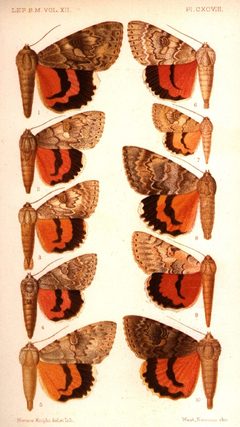
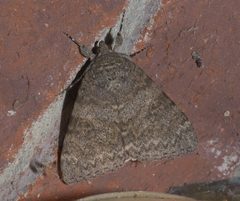
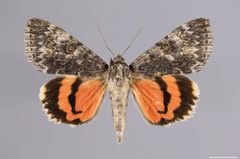
Distinguished from similar Catocala by the hooked inner hindwing band that points back toward the wing base rather than reaching the trailing edge. The orange-red hindwing coloration and specific band pattern separate it from with yellow or pink hindwings. The lighter marginal area on the hindwing upperside, separated by the outer black band, is a consistent feature. Forewing pattern of gray-brown with black bands is shared with many underwing species and not diagnostic alone.
Images
Habitat
Typically found near water where larval plants grow plentifully. Associated with riparian corridors, wetlands, and floodplains supporting willow and cottonwood . include cottonwood groves with adjacent wetlands in prairie regions, and mixed riparian woodlands in montane and foothill areas.
Distribution
Temperate North America: east to New York and Pennsylvania, west through Montana, Colorado, Oklahoma, Arizona, and Texas, north to southern Illinois, extreme southern Alberta and Saskatchewan. Also recorded west of the Rocky Mountains in California and south-eastern British Columbia.
Seasonality
on wing June to September, timing varying by location. Probably one per year.
Diet
Larvae feed on willow (Salix) and, in the western portion of the range, Fremont cottonwood (Populus fremontii). feeding habits not documented.
Host Associations
- Salix - larval willow
- Populus fremontii - larval Fremont cottonwood; western portion of range only
Life Cycle
Complete with probable one per year. stage not explicitly documented in sources. Larval stage feeds on plants; presumably in soil or leaf litter.
Behavior
are . Like other underwing moths, typically rests with forewings folded over body, concealing brightly colored hindwings. When disturbed, may flash hindwings as a startle defense. Generally does not come readily to lights, or remains on the periphery of lighted areas; sometimes found resting on tree trunks and must be flushed for observation.
Ecological Role
Larval herbivore on willows and cottonwoods. likely serve as prey for including bats and birds. Specific role not documented.
Human Relevance
Subject of interest to lepidopterists and citizen scientists; featured in National Week events. No documented economic importance. Historical taxonomic confusion with related has been resolved through recent synonymization of multiple described forms.
Similar Taxa
- Catocala electilisFormerly confused under the misapplied name C. aspasia; distinguished by hindwing band pattern and geography
- Catocala verillianaOverlapping range and similar size; distinguished by hindwing coloration and band details
- Catocala aholibahSympatric in some areas; larger size and different hindwing pattern
Misconceptions
The name 'Catocala aspasia' was frequently misapplied to this in older literature, actually referring to C. electilis. Multiple formerly described species and (including C. stretchii, the source of 'Stretch's underwing') have been synonymized with C. junctura as mere forms without taxonomic rank, though not all authors have adopted these changes.
More Details
Taxonomic history
has undergone significant taxonomic revision. Formerly placed in Noctuidae; now classified in Erebidae following molecular phylogenetic studies. Multiple forms previously described as distinct species or have been merged with C. junctura.
Conservation status
Not formally assessed; appears to be widespread and locally common in appropriate .
Sources and further reading
- BugGuide
- Wikipedia
- GBIF taxonomy match
- iNaturalist taxon
- NCBI Taxonomy
- Catalogue of Life
- A Gathering of Lepidopterists: Who's Who of the Butterfly, Moth Experts | Bug Squad
- Got Moths? Celebrate National Moth Week and Global Citizen Science
- Bug Eric: National Moth Week Recap, 2015
- Bug Eric: National Moth Week Recap for Colorado Springs
- Bug Eric: National Moth Week 2024 Recap from Kansas City
- Bug Eric: New Mexico Night Bugs