
Catocala jessica
H. Edwards, 1877
Jessica underwing
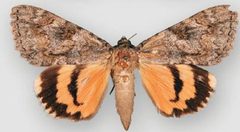
Catocala jessica, commonly known as the Jessica underwing, is a in the Erebidae. First described by Henry Edwards in 1877, this is found in western and central North America. The species is named with the specific epithet "jessica" and is one of many underwing moths in the Catocala, which are characterized by their cryptically patterned forewings and brightly colored hindwings.

Pronunciation
How to pronounce Catocala jessica: //ˌkætəˈkeɪlə ˈdʒɛsɪkə//
These audio files are automatically generated. While they are not always 100% accurate, they are a good starting point.
Identification
Distinguished from other Catocala by geographic distribution and association with Populus and Salix plants. Specific wing pattern details distinguishing C. jessica from similar underwing species are not documented in available sources. Genitalia dissection may be required for definitive identification from closely related species.
Images
Appearance
Wingspan approximately 75 mm. Forewings are cryptically patterned, typical of underwing moths, providing camouflage against tree bark. Hindwings are concealed at rest and display bright coloration when exposed, a characteristic feature of the Catocala.
Habitat
Associated with riparian and woodland where plants Populus (poplars, cottonwoods) and Salix (willows) occur. Specific microhabitat preferences are not documented.
Distribution
Documented from Arizona through Colorado to Illinois and California. Distribution records indicate presence in western and central North America.
Seasonality
are on wing from June to October. There is probably one per year.
Diet
Larvae feed on Populus and Salix . feeding habits are not documented.
Host Associations
- Populus - larval food plantpoplars, cottonwoods
- Salix - larval food plantwillows
Life Cycle
Probably one per year. Detailed stages and strategy are not documented.
Behavior
are . Specific behavioral traits such as attraction to light, patterns, or defensive are not documented.
Ecological Role
Larval herbivore on Populus and Salix. Specific ecological functions such as nutrient cycling or position are not documented.
Human Relevance
No documented economic or cultural significance. Not known to be a pest .
Similar Taxa
- Other Catocala speciesShare the underwing with cryptic forewings and brightly colored hindwings; require careful examination for differentiation
More Details
Etymology
The specific epithet "jessica" is a Latinized given name. The etymology was not explicitly stated in the original description, but follows the pattern of many Catocala named after women.
Sources and further reading
- BugGuide
- Wikipedia
- GBIF taxonomy match
- iNaturalist taxon
- NCBI Taxonomy
- Catalogue of Life
- Jessica Gillung: Absolute Dynamo | Bug Squad
- Jessica Gillung: Amazing Entomologist | Bug Squad
- Congrats, Entomologist Jessica Gillung! Recipient of Royal Entomological Society Award | Bug Squad
- Jessica Gillung's Research on Spider Flies: A Tale of Conflict and Uncertainty | Bug Squad
- 'Dr. Jessicles' Heading for Cornell | Bug Squad
- Everyone Wins! (Except the Spotted-Wing Drosophila) | Bug Squad