
Catocala amica
Hübner, 1818
girlfriend underwing
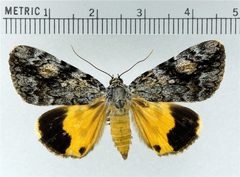
Catocala amica is a medium-sized underwing found across eastern and central North America. are distinguished by bright yellow hindwings with a black marginal band and separate black dot near the anal angle, combined with spineless tibiae. The is active from June to September and is attracted to ultraviolet light. Larvae feed exclusively on oak species (Quercus). The former C. a. lineella is now recognized as a distinct species, Catocala lineella.

Pronunciation
How to pronounce Catocala amica: /ˈkætəkələ ˈæmɪkə/
These audio files are automatically generated. While they are not always 100% accurate, they are a good starting point.
Identification
Distinguished from similar Catocala by the combination of: (1) yellow hindwing ground color with single black marginal band and separate anal dot (not two complete transverse bands), (2) complete absence of spines on all tibiae, and (3) forewing pattern lacking the additional features of C. lineella (formerly treated as a ). Forewing color is highly variable and not diagnostic alone. Examination of hindwing pattern and tibial armature is essential for reliable identification.
Images
Appearance
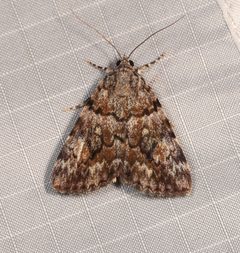
have a wingspan of 35–40 mm. Forewings are cryptically patterned with variable hue, serving as camouflage when at rest. Hindwings are bright yellow with a black band along the outer margin, except for the hindmost portion where a separate black dot is present near the anal angle. Unlike many , all tibiae lack spines. Similar sympatric typically display an additional black band across the central hindwings, which C. amica lacks.
Habitat
Associated with oak-dominated forests and woodlands. Occurs in supporting oak including Quercus sections Quercus and Lobatae. Found in dry mixed conifer forests with oaks at elevations around 7,000 feet, as well as lower elevation deciduous woodlands and forest edges.
Distribution
North America east of the Rocky Mountains. Range extends from southern Canada (Ontario, Quebec) southward through the eastern United States, westward to Oklahoma and Arizona, northward to Minnesota, and southwestward to Texas.
Seasonality
are active from June to September, with timing varying by location. Attracted to ultraviolet light at night.
Diet
Larvae feed on oak (Quercus), specifically: Quercus macrocarpa (bur oak), Q. prinus (chestnut oak), Q. prinoides (dwarf chinkapin oak), Q. stellata (post oak), Q. bicolor (swamp white oak), Q. alba (white oak), Q. ilicifolia (bear oak), Q. velutina (eastern black oak), Q. rubra (northern red oak), and Q. coccinea (scarlet oak). feeding habits are not documented.
Host Associations
- Quercus macrocarpa - larval bur oak
- Quercus prinus - larval chestnut oak
- Quercus prinoides - larval dwarf chinkapin oak
- Quercus stellata - larval post oak
- Quercus bicolor - larval swamp white oak
- Quercus alba - larval white oak
- Quercus ilicifolia - larval bear oak
- Quercus velutina - larval eastern black oak
- Quercus rubra - larval northern red oak
- Quercus coccinea - larval scarlet oak
Life Cycle
Complete with , larval, pupal, and stages. Specific details of oviposition, larval instars, site, and stage are not documented in available sources.
Behavior
are and attracted to ultraviolet light sources. When at rest, forewings are held together over the back, concealing the brightly colored hindwings—a posture that provides camouflage against tree bark. When disturbed, adults may flash hindwings to startle . Underwing moths typically remain on the periphery of light stations rather than landing directly on illuminated sheets.
Ecological Role
Larvae function as herbivores on oak foliage. likely serve as prey for including bats, birds, and spiders. Specific roles as or in nutrient cycling are not documented.
Human Relevance
Subject of interest to lepidopterists and enthusiasts, particularly during National Moth Week events. Attracted to blacklights and mercury vapor lamps used in citizen science monitoring. No documented economic importance as pest or beneficial .
Similar Taxa
- Catocala lineellaFormerly treated as C. a. lineella; now recognized as distinct (little lined underwing or steely underwing). Occurs to the north and east of C. amica. Separated by subtle differences in forewing pattern and hindwing banding.
- Other Catocala speciesMany sympatric underwing moths possess two complete black transverse bands on hindwings, or differently colored hindwings (orange, red, blue, or white). C. amica is distinguished by single yellow hindwing band with isolated anal dot and spineless tibiae.
More Details
Taxonomic history
Originally described by Jacob Hübner in 1818 as Ephesia amica. Formerly placed in Catocalinae of Noctuidae; now classified in Erebidae following revised circumscription of Noctuidae. Former C. a. lineella elevated to rank as Catocala lineella. Proposed as type species of Corisce by Hübner in 1823, but this genus has not been revalidated despite phylogenetic uncertainty in Catocala.
Sources and further reading
- BugGuide
- Wikipedia
- GBIF taxonomy match
- iNaturalist taxon
- NCBI Taxonomy
- Catalogue of Life
- A Gathering of Lepidopterists: Who's Who of the Butterfly, Moth Experts | Bug Squad
- Got Moths? Celebrate National Moth Week and Global Citizen Science
- Bug Eric: National Moth Week Recap, 2015
- Bug Eric: National Moth Week Recap for Colorado Springs
- Bug Eric: National Moth Week 2024 Recap from Kansas City
- Bug Eric: New Mexico Night Bugs