
Pareuchaetes insulata
Walker, 1855
yellow-winged pareuchaetes
Pareuchaetes insulata is a in the Erebidae, Arctiinae, first described by Francis Walker in 1855. Native to the Caribbean and southern United States, it has been introduced to South Africa as a agent for the weed Chromolaena odorata. The exhibits high specificity, with larvae feeding primarily on C. odorata. moths have a wingspan of 26–38 mm and are active year-round, peaking from April to November.
Pronunciation
How to pronounce Pareuchaetes insulata: //ˌpæriˈuːkeɪtiːz ˌɪnsuˈlɑːtə//
These audio files are automatically generated. While they are not always 100% accurate, they are a good starting point.
Identification
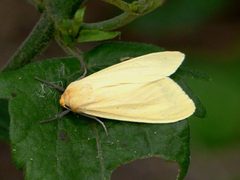
have a wingspan of 26–38 mm. The "yellow-winged pareuchaetes" suggests yellow coloration on the wings, though specific diagnostic features distinguishing it from such as P. pseudoinsulata and P. aurata aurata are not detailed in available sources. Genitalic characters are used for -level identification within the .
Images
Habitat
Native range includes tropical and subtropical regions of the Caribbean and southern United States. In South Africa, occurs in areas invaded by Chromolaena odorata, particularly in KwaZulu-Natal. Established at only one of 30 release sites despite extensive releases of approximately 1.9 million individuals.
Distribution
Native: Cuba, Antilles, southern United States (Arizona, Florida, South Carolina, Texas), Dominican Republic, El Salvador, Guatemala, Nicaragua. Introduced: South Africa (KwaZulu-Natal).
Seasonality
recorded on wing year-round, most abundant from April to November.
Diet
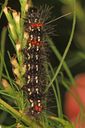
Larvae feed on leaves of Chromolaena odorata. In starvation tests with 48 plant , completed development only on C. odorata and Ageratum houstonianum, but subsequent culturing was only successful on C. odorata.
Host Associations
- Chromolaena odorata - primary larval food plant; approved for program in South Africa
- Ageratum houstonianum - secondary supported development in starvation tests but not sustainable for culturing
Life Cycle
Temperature-dependent development: survival and decline while development time prolongs at constant temperatures below 25°C. model estimates 3.9–10.0 per year in the weed's invaded range in South Africa. Low winter temperatures cause increased mortality, slow development, reduced fecundity, and increased exposure to natural enemies.
Behavior
Repeated defoliation of plant contributes to weed control. High host specificity demonstrated in starvation tests with 48 plant .
Ecological Role
agent for weed Chromolaena odorata in South Africa. Defoliation of plant contributes to weed suppression.
Human Relevance
Introduced to South Africa as a agent for Chromolaena odorata, an weed affecting plantations. Approved for release following specificity testing. Poor field establishment despite extensive releases, likely due to temperature limitations.
Similar Taxa
- Pareuchaetes pseudoinsulata with similar and use; previously misidentified as Ammalo insulata in literature; lays in batches rather than scattered
- Pareuchaetes aurata aurata evaluated as agent; native to Argentina; scatters around base of plant, potentially avoiding that affects P. pseudoinsulata
- Pareuchaetes insulataThe target itself; distinguishable by genitalic characters and geographic origin (Florida vs. Argentina for P. a. aurata)
Sources and further reading
- BugGuide
- Wikipedia
- GBIF taxonomy match
- iNaturalist taxon
- NCBI Taxonomy
- Catalogue of Life
- Meloidae Holdings | Entomology Research Museum
- Temperature-dependent performance and potential distribution of Pareuchaetes insulata, a biological control agent of Chromolaena odorata in South Africa
- The Life History Traits of the Arctiine MothPareuchaetes insulata, a Biological Control Agent ofChromolaena odoratain South Africa
- Host specificity ofPareuchaetes insulata (Lep.: Arctiidae), a biological control agent forChromolaena odorata (Compositae)
- Light environments affect herbivory patterns but not reproductive performance of a multivoltine specialist moth, Pareuchaetes pseudoinsulata
- Pheromones and glandular structures of both sexes of the weed‐defoliator moth Pareuchaetes pseudoinsulata Rego Barros (Lep., Arctiidae)
- The biology and host specificity of Pareuchaetes aurata aurata (Lepidoptera: Arctiidae), a ‘new association’ biological control agent for Chromolaena odorata (Compositae)
- The history of, and prospects for, the biological control of Chromolaena odorata (Compositae) by Pareuchaetes pseudoinsulata Rego Barros and allies (Lepidoptera: Arctiidae)