
Pareuchaetes
Grote, 1866
Species Guides
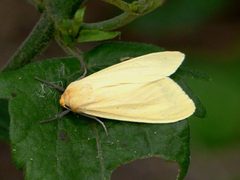
1- Pareuchaetes insulata(yellow-winged pareuchaetes)
Pareuchaetes is a of arctiine tussock moths in the Erebidae, erected by Augustus Radcliffe Grote in 1866. The genus contains six described distributed from the southern United States to northern Argentina. Several species have been employed as agents against the weed Chromolaena odorata in Africa and Asia, with varying degrees of establishment success. The genus is notable for its association with Chromolaena plants and its use in programs.
Pronunciation
How to pronounce Pareuchaetes: //ˌpær.iˈuː.kəˌtiːz//
These audio files are automatically generated. While they are not always 100% accurate, they are a good starting point.
Identification
-level identification within Arctiini requires examination of genitalic characters; male and female genitalia provide diagnostic features for distinguishing Pareuchaetes from related genera. -level identification relies on subtle differences in wing pattern, coloration, and genitalic . Pareuchaetes insulata has yellow wings and is sometimes called the yellow-winged pareuchaetes . Accurate identification typically requires dissection and comparison with published keys.
Images
Habitat
Native range spans tropical and subtropical regions of the Americas, from southern USA through Central America to northern Argentina. occupy where plants Chromolaena odorata and related species occur, including open disturbed areas, forest edges, and agricultural lands. Introduced in Africa and Asia inhabit similar environments in the invaded range of C. odorata, with some species showing preference for shaded versus full-sun habitats.
Distribution
Native: Americas (southern United States to northern Argentina). Introduced: Nigeria (early 1970s, re-established 2009), Ghana (mid-1990s), South Africa (KwaZulu-Natal, limited establishment), Guam, and other locations in Asia and Africa for of Chromolaena odorata.
Seasonality
Multivoltine with multiple per year; Pareuchaetes pseudoinsulata has 6-8 generations annually in Nigeria. Pareuchaetes insulata estimated at 3.9-10.0 generations per year in South Africa depending on temperature. and peak activity typically occur during wet or rainy seasons. Development slows and survival declines at temperatures below 25°C.
Diet
herbivores feeding on Chromolaena odorata (Asteraceae); larvae feed on leaves. Pareuchaetes pseudoinsulata larvae consume greater amounts of shaded foliage due to reduced leaf toughness and higher water and nitrogen content. Pareuchaetes aurata aurata has range limited to Chromolaena. Laboratory rearing uses 50% honey solution for .
Host Associations
- Chromolaena odorata - primary plant herbivore; laid on undersides of leaves, larvae feed on leaves. Shaded plants experience more herbivory in field conditions.
- Chromolaena jujuensis - native plantNative of Pareuchaetes aurata aurata in northern Argentina.
Life Cycle
Multivoltine with continuous breeding under favorable conditions. hatch after approximately 5 days. Development from larvae to takes 30-45 days at optimal temperatures. Egg-laying varies: P. pseudoinsulata lays eggs in batches on undersides of leaves; P. aurata aurata scatters eggs around base of plant. adults with dull yellow coloration in some .
Behavior
activity pattern. Larvae exhibit higher consumption rates on shaded foliage, interpreted as feedback and necessity consumption patterns due to high foliar nitrogen and water content. Preferentially feed on undamaged leaves when food is abundant. Sexual communication involves : females possess inner tubular glands with hydrocarbon pheromones; males have eversible hairbrush containing hydroxydanaidal, likely derived from in plant.
Ecological Role
agent for Chromolaena odorata; leaf feeding activities can significantly reduce plant cover. In Ghana and Guam, feeding reduced C. odorata from 80% to 30% cover. Helps mitigate threats to agriculture, biodiversity conservation, and livelihoods. Poor establishment in some regions attributed to , low winter temperatures, and natural enemy pressure.
Human Relevance
Intentionally introduced to multiple countries for of Chromolaena odorata, a serious weed in tropical Asia and Africa. Release efforts include approximately 1.9 million P. insulata individuals in South Africa with limited success. Taxonomic studies provide keys for identification of used in control programs. Monitoring using -based traps has been proposed to assess field .
Similar Taxa
- AmmaloHistorical misidentification; P. pseudoinsulata was previously misidentified as Ammalo insulata in literature.
- Other Arctiini generaRequire genitalic examination for separation; Pareuchaetes distinguished by specific male and female genitalic characters.
More Details
Taxonomic history
The was erected by Augustus Radcliffe Grote in 1866. A comprehensive taxonomic revision provided keys based on genitalic characters, three new synonyms, and one new combination. Pareuchaetes pseudoinsulata was misidentified as Ammalo insulata in previous literature.
Biological control outcomes
Establishment success varies dramatically by region and . P. pseudoinsulata failed to establish in Nigeria in the 1970s due to but was rediscovered near Benin City in 2009. P. insulata established at only one of 30 release sites in South Africa despite massive releases. P. aurata aurata was proposed as a 'new association' agent with different oviposition to overcome ant predation problems.
Sources and further reading
- BugGuide
- Wikipedia
- GBIF taxonomy match
- iNaturalist taxon
- NCBI Taxonomy
- Catalogue of Life
- Light environments affect herbivory patterns but not reproductive performance of a multivoltine specialist moth, Pareuchaetes pseudoinsulata
- Pheromones and glandular structures of both sexes of the weed‐defoliator moth Pareuchaetes pseudoinsulata Rego Barros (Lep., Arctiidae)
- Temperature-dependent performance and potential distribution of Pareuchaetes insulata, a biological control agent of Chromolaena odorata in South Africa
- The biology and host specificity of Pareuchaetes aurata aurata (Lepidoptera: Arctiidae), a ‘new association’ biological control agent for Chromolaena odorata (Compositae)
- The Life History Traits of the Arctiine MothPareuchaetes insulata, a Biological Control Agent ofChromolaena odoratain South Africa
- The history of, and prospects for, the biological control of Chromolaena odorata (Compositae) by Pareuchaetes pseudoinsulata Rego Barros and allies (Lepidoptera: Arctiidae)