
Gnophaela vermiculata
Grote, 1864
Police Car Moth, Police-Car Moth, Green Lattice
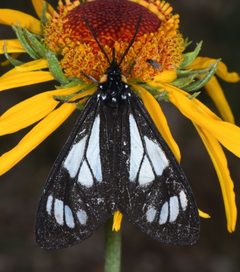
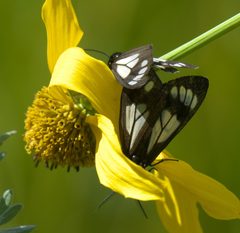
A day-flying of western North America, recognized by its striking black-and-white wing pattern with orange accents near the . The 'Police Car Moth' refers to this coloration, which resembles historical police vehicle markings. are active in late summer and visit flowers for nectar. Larvae feed on plants in the borage , particularly Mertensia, Lithospermum, and Hackelia .
Pronunciation
How to pronounce Gnophaela vermiculata: //nɔˈfæ.lə vɜːr.mɪ.kjʊˈleɪ.tə//
These audio files are automatically generated. While they are not always 100% accurate, they are a good starting point.
Identification
Distinguished from Gnophaela latipennis by larger pale areas on the wings and straighter forewing margins; G. latipennis has more rounded forewing margins and reduced pale patterning. The black-and-white lattice pattern with orange markings is distinctive among western North American .
Images
Appearance
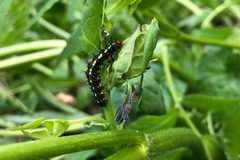
Wingspan approximately 54 mm. Wings display a bold black-and-white lattice or vermiculated pattern. Orange or yellowish patches present near the , visible in . Forewing margins relatively straight compared to . exhibit the black-and-white coloration; larvae are born with yellower patches and develop the adult coloration pattern as they mature.
Habitat
Associated with montane and subalpine regions of the Rocky Mountains and western cordillera. Occupies where plants in the Mertensia, Lithospermum, and Hackelia occur, typically open meadows, forest edges, and riparian zones in mountainous terrain.
Distribution
Western North America from British Columbia and Alberta (Canada) south through the Rocky Mountain states to California, east to New Mexico, and north to Manitoba. Core range centers on the Rocky Mountain region of the United States.
Seasonality
active in late summer. : one per year. period coincides with flowering of nectar sources including Cirsium and Solidago.
Diet
Larvae feed on foliage of Mertensia, Lithospermum, and Hackelia (Boraginaceae). feed on nectar of various herbaceous flowers, including Cirsium (thistles) and Solidago (goldenrods).
Host Associations
- Mertensia - larval food plantBoraginaceae
- Lithospermum - larval food plantBoraginaceae
- Hackelia - larval food plantBoraginaceae
- Cirsium - nectar sourceAsteraceae
- Solidago - nectar sourceAsteraceae
Life Cycle
Holometabolous with complete . : one annually. Larvae overwinter, pupate, and emerge as in late summer. Larvae born with yellower patches, developing adult coloration as they mature.
Behavior
: fly during daylight hours, unusual among . Has been observed to visit flowers for nectar. The orange markings may flash visibly in , potentially contributing to the 'police car' through resemblance to emergency vehicle lighting.
Ecological Role
function as when visiting flowers for nectar. Larvae are herbivores specializing on Boraginaceae. The aposematic coloration suggests chemical defense, though specific compounds have not been documented for this .
Human Relevance
None documented. Occasionally noted by naturalists and photographers due to its striking appearance and habits. Not a pest .
Similar Taxa
- Gnophaela latipennisSimilar black-and-white lattice pattern, but distinguished by smaller pale wing areas and more rounded forewing margins
More Details
Taxonomic History
Originally described by Augustus Radcliffe Grote in 1864 as Omoiala vermiculata. Now classified in Erebidae, Arctiinae, reflecting modern revisions of higher-level that have separated this group from the former '' and 'Noctuidae' concepts.
Etymology
Specific epithet 'vermiculata' refers to the worm-like or vermiculated pattern on the wings. 'Police Car Moth' references the black-and-white coloration with orange 'flashing' accents, resembling historical police vehicle markings.