
Macrocneme
Hübner, 1818
Species Guides
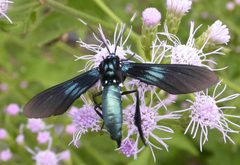
1- Macrocneme chrysitis(Southern Cyan Tiger Moth)
Macrocneme is a of tiger moths in the Erebidae, Arctiinae. in this genus are known for their mimicry of spider wasps (Pompilidae), displaying aposematic coloration and body form that resembles hymenopteran . This represents a defensive where gain protection from predators by resembling dangerous or unpalatable species. The genus was established by Hübner in 1818 and contains multiple species distributed primarily in the Americas.
Pronunciation
How to pronounce Macrocneme: /ˌmæ.kroʊkˈniːm/
These audio files are automatically generated. While they are not always 100% accurate, they are a good starting point.
Identification
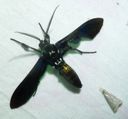
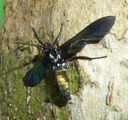
Macrocneme can be distinguished from other tiger moths by their -mimicking , including narrow, elongated bodies, long legs, and color patterns that resemble spider wasps. Unlike clearwing moths (Sesiidae) that achieve wasp mimicry through transparent wings, Macrocneme retains scaled wings with bold contrasting patterns. They differ from -mimicking sphingids such as Hemaris by their more slender build and different wing shape. The can be separated from other wasp-mimicking Arctiinae such as Pseudosphex by specific pattern elements and body proportions, though precise identification to species level requires examination of genitalia and other technical characters.
Images
Distribution
of Macrocneme are distributed in the Americas, with records from North, Central, and South America. Specific range limits vary by species within the .
Behavior
are active mimics of spider wasps, employing Batesian or Müllerian mimicry to avoid . The -like appearance includes behavioral components such as rapid, darting patterns that enhance the illusion.
Human Relevance
Featured in entomological outreach and museum exhibits demonstrating mimicry complexes in Lepidoptera, including displays at the Bohart Museum of Entomology highlighting and mimics among .
Similar Taxa
- PseudosphexAnother of Arctiinae that mimics ; differs in specific pattern elements and body proportions.
- HemarisSphingidae that mimics bumble bees; has transparent wing areas and more robust body form compared to the slender, -mimicking Macrocneme.
- Paranthrene robiniaeSesiidae clearwing moth that mimics through transparent wings rather than patterned scaled wings.
More Details
Mimicry Type
Macrocneme represents a classic example of mimicry in Lepidoptera, specifically resembling spider wasps (Pompilidae) rather than bees or social wasps.