
Macrocneme chrysitis
Guérin-Méneville, 1844
Southern Cyan Tiger Moth
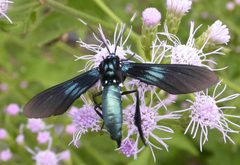
Macrocneme chrysitis, commonly known as the Southern Cyan Tiger Moth, is a tiger moth in the Arctiinae. First described in 1844, this is notable for its mimicry of spider wasps (Pompilidae), a defensive that deters . It occurs from the southern United States through Central America to southern Brazil.
Pronunciation
How to pronounce Macrocneme chrysitis: /ˌmakroʊnˈiːmi ˈkraɪsɪtɪs/
These audio files are automatically generated. While they are not always 100% accurate, they are a good starting point.
Identification
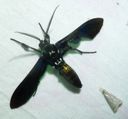
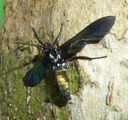
Distinguished from other tiger moths by its narrow-winged, -mimicking form and distinctive cyan-blue forewing coloration. The orange-red abdominal banding is visible in and at rest. Separated from actual spider wasps by filamentous (not elbowed), two pairs of wings (not one), and the presence of on wings. Similar Macrocneme require examination of genitalia or geographic range for definitive identification.
Images
Appearance
exhibit aposematic coloration with metallic blue-green or cyan forewings and contrasting orange or red abdominal segments. The body is slender with a -like profile, including a constricted waist. Wings are relatively narrow compared to many tiger moths. The overall appearance closely resembles spider wasps in the Pompilidae.
Distribution
Texas (United States); Mexico; Guatemala; Nicaragua; Panama; Rio Grande do Sul, Brazil
Behavior
are or , unusual for tiger moths. pattern mimics that of spider wasps, with rapid, darting movements and hovering capability. This behavioral mimicry complements visual resemblance to .
Ecological Role
mimicry serves as a defensive against vertebrate , representing a case of . The contributes to mimicry complexes involving hymenopteran models in Neotropical and Nearctic .
Human Relevance
Occasionally featured in entomological outreach and museum exhibits as an example of mimicry of hymenopterans. The demonstrates that moth mimicry extends beyond the well-known -mimicking clearwing moths (Sesiidae) and hummingbird moths (Sphingidae).
Similar Taxa
- Paranthrene robiniaeSesiidae clearwing moth that also mimics , but has transparent wings and different body shape
- Hemaris thetisSphingidae -mimicking with more robust body and different pattern
- Other Macrocneme species share -mimicking but differ in coloration, pattern, and geographic distribution
More Details
Taxonomic note
Formerly placed in , now classified in Erebidae (Arctiinae) following molecular phylogenetic revisions of Noctuoidea.
Mimicry type
The mimicry in this represents a less commonly documented example among tiger moths, which more frequently exhibit warning coloration without precise morphological mimicry of stinging insects.