
Pseudosphex leovazquezae
Pérez & Sánchez, 1986
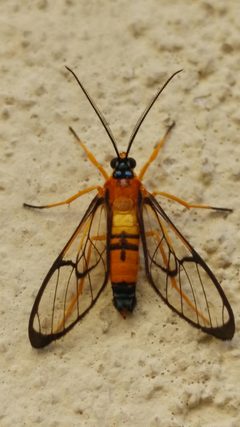
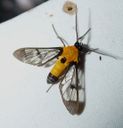
Pseudosphex leovazquezae is a in the Arctiinae (tiger moths) described by Pérez and Sánchez in 1986. The is known from southern Texas, Mexico, and Guatemala. are active from September to November in Texas. Like other members of its , it exhibits mimicry, displaying yellow-black patterning and transparent wings that closely resemble stinging wasps.
Pronunciation
How to pronounce Pseudosphex leovazquezae: //ˌsjuː.doʊˈsfɛks ˌleɪ.oʊ.væˈskɛz.aɪ//
These audio files are automatically generated. While they are not always 100% accurate, they are a good starting point.
Identification
Members of the Pseudosphex are distinguished from other Arctiinae by their highly accurate mimicry, featuring a constricted wasp-waist, yellow and black coloration, transparent wings that are folded at rest like wasps, and resembling those of vespid wasps. Specific identification of P. leovazquezae likely requires examination of genitalia or detailed wing pattern analysis; the was originally described from Mexico and may be separated from by subtle differences in forewing markings and body proportions.
Images
Distribution
Southern Texas (United States), Mexico, and Guatemala. Distribution records confirm presence in North America.
Seasonality
are on wing from September to November in Texas.
Behavior
are (day-active), an unusual trait for that facilitates their -mimicry deception. Based on research on congeneric , precise wasp resemblance may function not only to deter vertebrate but potentially to avoid by the wasps themselves, which may not attack individuals resembling conspecifics.
Similar Taxa
- Pseudosphex laticinctaA congeneric with nearly identical -mimicry appearance; both exhibit yellow-black patterning, transparent folded wings, and wasp-waist . Geographic range and subtle wing pattern differences may aid separation.
- Macrocneme speciesOther Arctiinae that mimic spider wasps; differ in specific body proportions and wing transparency patterns.
- Sesiidae (clearwing moths)Also transparent-winged mimics, but have different wing venation and body structure; Sesiidae typically have more extensive wing transparency and different antennal .
- Hemaris thetis (Sphingidae)A hummingbird clearwing moth that mimics bumble bees rather than ; has more robust body, different pattern, and lacks the pronounced wasp-waist of Pseudosphex.
More Details
Taxonomic Note
Originally described as Abrochia leovazquezae by Pérez and Sánchez in 1986; subsequently transferred to Pseudosphex. placement has shifted from to Erebidae ( Arctiinae) following modern molecular phylogenetic revisions of Lepidoptera.