
Apantesis virguncula
(Kirby, 1837)
Little Virgin Tiger Moth
Apantesis virguncula, commonly known as the Little Virgin Tiger Moth, is a tiger moth in the Erebidae. The was originally described by W. Kirby in 1837 under the name Callimorpha virguncula, and has undergone several taxonomic revisions, most recently being transferred from the Grammia to Apantesis. It is widely distributed across southern Canada and the United States, with active primarily from mid-June to late July. The larvae feed on various herbaceous plants, particularly members of the family Asteraceae.
Pronunciation
How to pronounce Apantesis virguncula: /əˈpæn.tə.sɪs vɜrˈɡʌŋ.kjʊ.lə/
These audio files are automatically generated. While they are not always 100% accurate, they are a good starting point.
Identification
Distinguished from other Apantesis by combination of size, geographic range, and pattern details. Forewing length of 13.9–20.5 mm helps separate it from larger . The species was formerly placed in Grammia, and specimens may still be labeled under that in older collections. Accurate identification often requires examination of genitalia or comparison with closely related species such as Apantesis parthenice (Parthenice Tiger Moth) and Apantesis phalerata (Harnessed Tiger Moth), which overlap in range but differ in specific wing pattern elements.
Images
Appearance
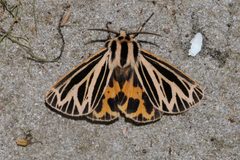
Forewing length ranges from 13.9–20.5 mm. As a tiger moth in the Apantesis, it displays the characteristic bold patterning typical of the group, with contrasting light and dark markings on the forewings. The hindwings typically feature bright warning coloration, often orange or red with dark spots, a trait common among arctiine . The body is moderately robust with a furry . Specific color patterns vary but generally include pale stripes or bands against darker backgrounds.
Habitat
Occurs in a variety of open and semi-open including meadows, fields, prairies, woodland edges, and disturbed areas. The thrives in environments supporting its larval plants, particularly those with abundant herbaceous vegetation. Habitats with diverse flowering plants that attract for nectar are also favored.
Distribution
Widely distributed across most of southern Canada and the United States, from the Rocky Mountains eastward. Northern range extends to northern Alberta, Saskatchewan, Manitoba, and Newfoundland. Southern range follows the Rocky Mountains to Apache County, Arizona, and eastward to New Jersey. Absent from much of the southeastern United States and the Pacific coastal region.
Seasonality
are generally on wing from mid-June to late July, with records spanning late May to late August. Peak activity occurs during the summer months in most of its range.
Diet
Larvae feed on various herbaceous plants, with a preference for in the Asteraceae. Documented plants include dandelion (Taraxacum), knotweed (Polygonum), and plantain (Plantago). feeding habits are not specifically documented but likely include nectar from available flowers.
Host Associations
- Taraxacum - larval food plantdandelion
- Polygonum - larval food plantknotweed
- Plantago - larval food plantplantain
Life Cycle
Complete with four stages: , larva, pupa, and . Larvae are ground-dwelling or low-feeding caterpillars that consume herbaceous vegetation. likely occurs in leaf litter or soil, though specific details are not well documented. Adults emerge in summer and are , attracted to light sources.
Behavior
are and strongly attracted to ultraviolet and mercury vapor lights. They are typical of tiger moths in exhibiting warning coloration, likely serving as aposematic signals to . The is not known to be day-flying. Larvae are solitary feeders on low-growing plants.
Ecological Role
Larval herbivore that contributes to nutrient cycling through consumption of herbaceous vegetation. As a member of the tiger moth Arctiinae, may serve as prey for bats, birds, and other , with their bright hindwing coloration functioning in deterrence through startle displays or warning signals. The participates in pollination as adults visit flowers.
Human Relevance
Occasionally encountered by entomologists and citizen scientists during surveys and National Moth Week events. Not considered an agricultural pest. The serves as an example of taxonomic revision in Lepidoptera, illustrating the dynamic nature of moth classification. Its attractive appearance makes it a subject of interest for nature photographers and moth enthusiasts.
Similar Taxa
- Apantesis partheniceOverlapping range and similar size; differs in specific wing pattern details and forewing markings
- Apantesis phalerataSimilar preferences and geographic distribution; distinguished by harness-like pattern on forewings
- Grammia species (now Apantesis)Formerly classified in same ; many share similar tiger moth coloration and require careful examination for separation
More Details
Taxonomic History
This has undergone significant taxonomic revision. Originally described as Callimorpha virguncula by Kirby in 1837, it was later placed in Grammia virguncula. Recent molecular and morphological studies led to the transfer of species from Grammia, Holarctia, and Notarctia into the expanded Apantesis. This revision reflects ongoing research into the phylogenetic relationships within the tiger moth Arctiinae.
Conservation Status
Not formally assessed by major conservation organizations. The appears to remain common across its broad range, though like many insects, it may be affected by loss, use, and changes in land management practices such as fire suppression or excessive prescribed burning.
Sources and further reading
- BugGuide
- Wikipedia
- GBIF taxonomy match
- iNaturalist taxon
- NCBI Taxonomy
- Catalogue of Life
- Bug Eric: National Moth Week 2021 Review
- Bug Eric: Remembering National Moth Week 2018
- Sphingidae | Beetles In The Bush | Page 2
- Bug Eric: October 2018
- The Moth and Me | Beetles In The Bush
- Saturniidae | Beetles In The Bush | Page 2