
Apantesis obliterata
(Stretch, 1885)
Steppe Tiger Moth
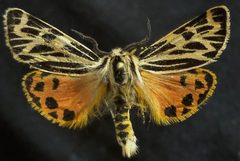
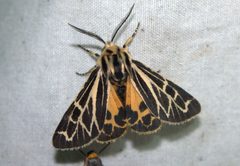
Apantesis obliterata is a tiger moth in the Erebidae, originally described from North America in 1885. It exhibits a transcontinental distribution spanning northern Eurasia and North America, with in Russia, Mongolia, and the Canadian prairie provinces. The inhabits grassland and is active in late summer and early autumn. It was transferred from the Grammia to Apantesis as part of a broader taxonomic reorganization of tiger moths.

Pronunciation
How to pronounce Apantesis obliterata: /əˈpæn.tə.sɪs ˌɒb.lɪˈtɛr.ə.tə/
These audio files are automatically generated. While they are not always 100% accurate, they are a good starting point.
Identification
The small forewing length of approximately 16 mm distinguishes this from larger Apantesis . The specific epithet 'obliterata' (meaning 'erased' or 'obliterated') may refer to reduced or faint wing markings, though this interpretation is speculative. Accurate identification requires examination of genitalia or molecular analysis, as wing patterns within Apantesis are often similar and variable. The species is most readily identified by its occurrence in the northern Great Plains and adjacent regions during late summer.
Images
Habitat
Grasslands. Specific vegetation associations are not documented.
Distribution
Russia (Khakasia, eastern Sayan, southern Baikal region, Transbaikalia, Middle Amur basin, central Yakutia), Mongolia, and North America (Alberta, Saskatchewan, Manitoba, Northwest Territories).
Seasonality
are on wing in late summer and early fall.
Diet
Larvae probably feed on various herbaceous plants.
Similar Taxa
- Apantesis phalerataOverlaps in North American prairie distribution and shares similar grassland ; requires careful examination to distinguish.
- Grammia species (former congeners)Formerly classified in the same ; similar size range and general tiger moth appearance, though Grammia typically have more boldly patterned wings.
More Details
Taxonomic History
This was originally described by Richard Harper Stretch in 1885. It was formerly placed in the Grammia, but was transferred to Apantesis along with other species from the genera Grammia, Holarctia, and Notarctia as part of a taxonomic revision of tiger moths.
Beringian Distribution
The trans-Beringian distribution pattern, with in both northern Asia and northwestern North America, is shared with several other Apantesis and reflects historical connections between these regions during Pleistocene glaciations.
Sources and further reading
- BugGuide
- Wikipedia
- GBIF taxonomy match
- iNaturalist taxon
- NCBI Taxonomy
- Catalogue of Life
- Bug Eric: National Moth Week 2021 Review
- Bug Eric: Remembering National Moth Week 2018
- Sphingidae | Beetles In The Bush | Page 2
- Bug Eric: October 2018
- The Moth and Me | Beetles In The Bush
- Saturniidae | Beetles In The Bush | Page 2