
Stigmella microtheriella
(Stainton, 1854)
Hazel leaf miner moth, Hazel Leafminer Moth
Stigmella microtheriella is a minute leaf-mining in the Nepticulidae, with a wingspan of only 3–4 mm. The is native to Europe and Asia, and was introduced to New Zealand from Britain between 1850 and 1860, likely via imported hazel trees. Its larvae create distinctive narrow, angular mines in the leaves of hazel (Corylus species) and hornbeams (Carpinus species). are parthenogenetic and fly in May and August.
Pronunciation
How to pronounce Stigmella microtheriella: /ˈstɪɡ.mɛlə ˌmi.kroʊ.θɪəriˈɛlə/
These audio files are automatically generated. While they are not always 100% accurate, they are a good starting point.
Identification
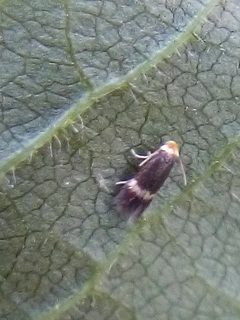
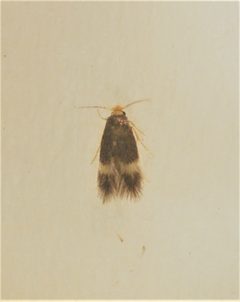
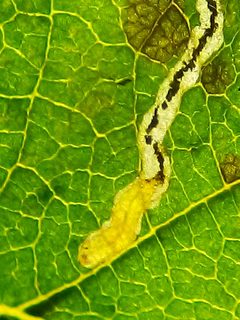
This can be distinguished from similar Stigmella species by the combination of its extremely small size (3–4 mm wingspan), the purplish-fuscous forewings with a distinct oblique whitish fascia beyond the middle, and the darker purple area. The larval mines are diagnostic: narrow, often angular, with linear filling less than half of the mine width, widening gradually but never exceeding the width of the larva. The is ochreous-yellowish rather than darker colors seen in some .
Images
Appearance
are extremely small with a wingspan of 3–4 mm. The is ochreous-yellowish with an ochreous-whitish collar. Antennal eyecaps are ochreous-whitish. Forewings are purplish-fuscous with a rather oblique shining whitish fascia beyond the middle; the area beyond this fascia is darker and more purple. Hindwings are grey.
Habitat
Found in areas where plants (hazel and hornbeam) occur, including woodlands, hedgerows, and cultivated hazelnut orchards. In New Zealand, it has spread from its original introduction site in Nelson to both North and South Islands, inhabiting areas with introduced hazel .
Distribution
Native to Europe and the eastern . Introduced to New Zealand, where it was first recorded in Nelson (Maitai Valley and Broadgreen Historic House grounds) and has since spread throughout both islands. GBIF records also indicate presence in Belgium.
Seasonality
are on wing in May and again in August. The pattern produces two per year.
Diet
Larvae feed as leaf miners on hazel (Corylus avellana, C. colurna, C. maxima) and hornbeam (Carpinus betulus, C. orientalis), as well as hop-hornbeam (Ostrya carpinifolia, O. virginiana). do not feed; they are parthenogenetic.
Host Associations
- Corylus avellana - larval plantcommon hazel
- Carpinus betulus - larval plantEuropean hornbeam
- Corylus colurna - larval plantTurkish hazel
- Corylus maxima - larval plantfilbert
- Carpinus orientalis - larval plantOriental hornbeam
- Ostrya carpinifolia - larval plantEuropean hop-hornbeam
- Ostrya virginiana - larval plantAmerican hophornbeam
Life Cycle
are laid on the underside of leaves, usually near a rib. Larvae are yellow with a bright green gut and light brown ; they feed venter-upwards, creating narrow, angular mines. The cocoon is yellowish brown or pinkish and formed on the ground. emerge in May and August; the is parthenogenetic.
Behavior
Larvae feed with their surface upward, creating distinctive narrow mines. The is parthenogenetic, meaning females can produce offspring without mating.
Ecological Role
As a , larvae feed between the epidermal layers of plant leaves, creating visible mines. In New Zealand, where it is introduced, it has become an agricultural pest for hazelnut . The may serve as a food source for and other natural enemies, though specific records are not documented.
Human Relevance
In New Zealand, regarded as an agricultural pest for those farming hazel . The species was accidentally introduced via horticultural trade of hazel trees from Britain. Elsewhere, it is primarily of ecological interest as a specialized herbivore of temperate broadleaf trees.
Similar Taxa
- Stigmella multispicataAnother small Stigmella leafminer, but feeds on Siberian elm (Ulmus pumila) rather than hazel/hornbeam; has different wing pattern and association
- Stigmella castaneaefoliella on Castanea (chestnut) rather than Corylus/Carpinus; distinct plant specificity separates the
- Other Stigmella species on BetulaceaeMany Stigmella mine leaves of birch plants; S. microtheriella is distinguished by its specific combination of small size, wing pattern with oblique whitish fascia, and larval mine characteristics
More Details
Parthenogenesis
The is parthenogenetic, meaning occurs without . This trait is relatively uncommon among Lepidoptera and may facilitate establishment in new areas with limited initial sizes.
Etymology
The specific epithet 'microtheriella' derives from Greek 'micros' (small) and 'therion' (little creature), reflecting that the was thought to be the smallest known when described. The name 'Stigmella' refers to the conspicuous, sometimes metallic, fascia on the wings of many species in the genus.
New Zealand invasion history
Introduced between 1850–1860 by Mr. Smith of Smith's Ford, Maitai Valley, Nelson, who imported hazel trees from Britain. As of 1989, known only from Nelson, but has since spread throughout both islands.