
Stigmella macrocarpae
(Freeman, 1967) van Nieukerken et al., 2016
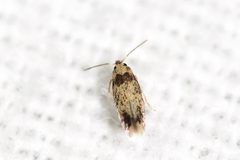
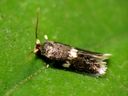
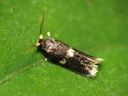
Stigmella macrocarpae is a pygmy in the Nepticulidae, named for its association with Quercus macrocarpa (bur oak). The occurs across eastern and central North America, with extending to the Pacific Northwest. Larvae are leaf miners that feed internally on oak leaves, creating distinctive serpentine mines. The species was originally described as Stigmella latifasciella in 1878, but this name was preoccupied by a European species, necessitating the current name established in 2016.
Pronunciation
How to pronounce Stigmella macrocarpae: //stɪɡˈmɛlə ˌmækroʊˈkɑrpi//
These audio files are automatically generated. While they are not always 100% accurate, they are a good starting point.
Identification
are minute typical of Nepticulidae, with wingspans generally under 5 mm. The can be distinguished from other North American Stigmella by genital and . Larval mines on Quercus leaves appear as narrow, winding trails (serpentine mines) that may widen slightly as the larva matures. is deposited in a continuous central line within the mine. The species is associated specifically with oak , particularly Quercus macrocarpa and Quercus rubra, which aids in field identification where host data are available.
Images
Habitat
Deciduous forests and woodlands containing oak trees, particularly those with Quercus macrocarpa (bur oak) and Quercus rubra (northern red oak). Occurs in both mature forest stands and fragmented woodland patches in urban and suburban areas.
Distribution
North America: United States (Arkansas, Florida, Georgia, Illinois, Indiana, Kentucky, Maryland, Massachusetts, Michigan, New York, Ohio, Pennsylvania, South Carolina, Virginia, West Virginia) and Canada (Ontario, British Columbia). The shows a disjunct distribution with eastern centered in the oak-hickory forests of the Midwest and Appalachia, and western populations in the Pacific Northwest.
Seasonality
Probably three per year across most of its range. have been recorded from spring through fall, with peak activity varying by latitude.
Diet
Larvae feed on Quercus , specifically Quercus macrocarpa (bur oak) and Quercus rubra (northern red oak). They mine the leaves of their plant, feeding on mesophyll tissue between the upper and lower .
Host Associations
- Quercus macrocarpa - Namesake ; larvae mine leaves
- Quercus rubra - Larvae mine leaves
Life Cycle
Holometabolous. are laid on oak leaves. Larvae feed as leaf miners, creating serpentine mines. occurs in a cocoon, typically in leaf litter or soil. Multiple per year are suspected in most of the range.
Behavior
Larvae are endophagous leaf miners that feed internally within oak leaf tissue. are likely or , as is typical for Nepticulidae, though specific adult has not been documented.
Ecological Role
As a , larvae contribute to herbivore pressure on oak and may serve as prey for and other natural enemies. The is part of the diverse of oak-associated Lepidoptera in eastern North American forests.
Human Relevance
No direct economic or agricultural significance. The may be of interest to lepidopterists and ecologists studying oak forest . Its leaf mines are occasionally noted by naturalists and can be documented through citizen science platforms.
Similar Taxa
- Other Stigmella species on QuercusMultiple Stigmella mine oak leaves; identification requires examination of genitalia or
- Stigmella latifasciella (European)The name was preoccupied by this European , necessitating the replacement name S. macrocarpae; the two species are not
More Details
Nomenclatural history
Originally described by Chambers in 1878 as Stigmella latifasciella, but this name was already in use for a European described by Herrich-Schäffer in 1855. The replacement name S. macrocarpae was established by van Nieukerken et al. in 2016.
Sources and further reading
- BugGuide
- Wikipedia
- GBIF taxonomy match
- iNaturalist taxon
- NCBI Taxonomy
- Catalogue of Life
- When the American Chestnut Vanished, What Happened to Insects That Fed On It?
- biodiversity | Blog - Part 35
- Amateur botanists in Brazil discover a genuflexing plant | Blog
- Amateur botanists in Brazil discover a genuflexing plant. Portuguese: Botânicos amadores no Brasil descobrem uma planta que faz genuflexão. | Blog
- The Insects Behind the Weird Growths on Plants