
Stigmella anomalella
(Goeze, 1783) Walsingham, 1908
rose leaf miner
Stigmella anomalella is a microlepidopteran in the Nepticulidae, commonly known as the rose . are active from May to August with two per year. The larvae are leaf miners that feed on various Rosa and related plants in the Rosaceae family, creating distinctive corridor mines with hairpin turns in leaves.
Pronunciation
How to pronounce Stigmella anomalella: //stɪɡˈmɛlə ænəməˈlɛlə//
These audio files are automatically generated. While they are not always 100% accurate, they are a good starting point.
Identification
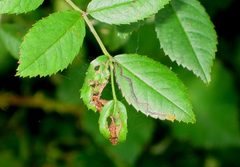
Distinguished from other Stigmella by the combination of greenish-bronzy forewings with purple fourth and specific larval association with Rosa and related . The larval mine is diagnostic: a clear corridor often with a hairpin turn, with the section before the turn frequently following the leaf margin; first section of mine entirely filled with . occurs outside the mine. Similar leaf-mining nepticulids on Rosaceae may be distinguished by mine and wing coloration.
Images
Appearance
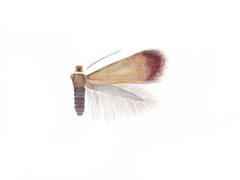
Very small with wingspan 5–6 mm. Forewings shining greenish-bronzy, lighter posteriorly, with fourth purple. ferruginous-orange to black. Collar yellow-whitish. Antennal eyecaps whitish. Hindwings grey.
Habitat
Associated with supporting plants in the Rosaceae , particularly Rosa . Found in various environments where roses grow, including woodlands, hedgerows, gardens, and semi-natural vegetation.
Distribution
Europe (widespread), extending east through the to eastern parts of that region. GBIF records indicate presence in Belgium and other European countries, with distribution spanning West and East Palearctic regions.
Seasonality
on wing from May to August. Two per year.
Diet
Larvae feed on leaves of Potentilla caulescens, Rosa arkansana, Rosa canina, Rosa centifolia, Rosa glauca, Rosa pendulina, Rosa rubiginosa, Rosa rugosa, Rosa tomentosa, Rosa wichurana, Sanguisorba minor, and Sanguisorba officinalis. Larvae mine leaves, creating corridor mines. feeding habits not documented.
Host Associations
- Potentilla caulescens - larval leaf mining
- Rosa arkansana - larval leaf mining
- Rosa canina - larval leaf mining
- Rosa centifolia - larval leaf mining
- Rosa glauca - larval leaf mining
- Rosa pendulina - larval leaf mining
- Rosa rubiginosa - larval leaf mining
- Rosa rugosa - larval leaf mining
- Rosa tomentosa - larval leaf mining
- Rosa wichurana - larval leaf mining
- Sanguisorba minor - larval leaf mining
- Sanguisorba officinalis - larval leaf mining
Life Cycle
with two per year. Larvae mine leaves of plants, creating corridor mines often with hairpin turns; first section of mine filled with . takes place outside the mine. Specific details of -laying and pupal stage not documented.
Behavior
Larvae are endophagous leaf miners, feeding internally within leaf tissue and creating visible mines. No other specific documented.
Ecological Role
As a , larvae contribute to herbivory pressure on Rosa and related plants. Specific ecological impacts or interactions with or not documented.
Human Relevance
May be encountered in gardens and horticultural settings where roses are cultivated. Not documented as a significant pest . 'rose ' reflects association with cultivated and wild roses.
Similar Taxa
- Stigmella multispicataAnother Nepticulidae , but associated with Ulmus (elm) rather than Rosa; different specificity and geographic distribution
- Stigmella castaneaefoliellaNepticulidae on Castanea (chestnut); distinct association and mine
- Other Stigmella species on RosaceaeMay be distinguished by specific mine (hairpin turn, pattern) and wing coloration
More Details
Taxonomic history
Originally described as Phalaena anomalella by Goeze in 1783, later transferred to Stigmella by Walsingham in 1908.
Leaf mine characteristics
The larval mine is a clear corridor, often with a hairpin turn. The section before the turn often follows the leaf margin. The first section of the mine is entirely filled with , distinguishing it from some related .