
Phymatopus
Wallengren, 1869
swift moths, ghost moths
Species Guides
3- Phymatopus behrensii
- Phymatopus californicus(Lupine Ghost Moth)
- Phymatopus hectoides(Orange-Lined Ghost Moth)
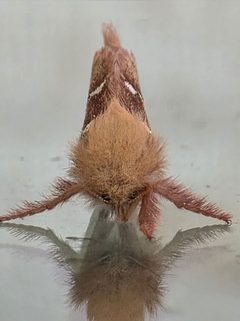
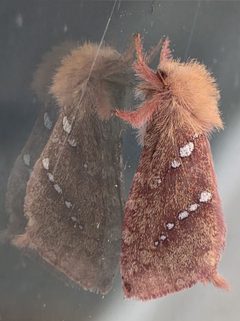
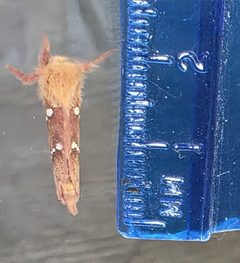
Phymatopus is a of swift moths in the Hepialidae, erected by Wallengren in 1869. The genus occurs across Eurasia and western North America, with distinguished primarily by male genitalia and forewing pattern variation. Members lack tibial spurs, , , and have very short . The genus exhibits an unusual mating system where males release attractants to draw females, reversing the ancestral hepialid condition.
Pronunciation
How to pronounce Phymatopus: /faɪˈmætəpəs/
These audio files are automatically generated. While they are not always 100% accurate, they are a good starting point.
Identification
identification relies on examination of male genitalia: shape of and processes of valvella, mesosome tip , and eighth abdominal sternum. Forewing stripe characteristics provide supplementary clues: spot separation versus confluence, metallic lustre presence, and stripe continuity. P. hecta has silvery-white metallic stripes with separated spots; P. hectica has golden-yellow or whitish non-metallic confluent spots; P. japonicus has uninterrupted outer stripe with four to five silvery spots at apex.
Images
Habitat
Associated with supporting larval plants including bracken (Pteridium), heaths (Erica, Calluna), and various herbaceous vegetation. Western North American occupy coastal regions with Baccharis, Eriophyllum, and other shrubby vegetation. Larval tunnels occur in stems at soil interface and in root tissues.
Distribution
Eurasia: central and northern Europe, Ural Mountains, Russian Far East (Sakhalin, Kuril Islands, eastern Russia), Japan (Hokkaido). North America: western coastal United States (California and adjacent regions), restricted to areas north of Mexico. Eurasian range represented solely by P. hecta; North America by three geographically restricted .
Diet
Larvae are root and stem borers, feeding internally on plant tissues. Recorded food plants include bracken fern (Pteridium), brooms (Baccharis), woolly sunflower (Eriophyllum), sneezeweed (Helenium), lupines (Lupinus), apple (Malus), Horkelia, figworts (Scrophularia), and roots of heaths (Erica, Calluna), primrose (Primula), and docks (Rumex). lack functional mouthparts and do not feed.
Host Associations
- Pteridium - food plantPrimary for P. hecta and P. japonicus
- Baccharis - food plantRecorded for P. californicus and P. hectoides
- Eriophyllum - food plantRecorded for P. californicus
- Helenium - food plantRecorded for P. behrensii
- Lupinus - food plantRecorded for P. behrensii
- Malus - food plantRecorded for P. behrensii
- Horkelia - food plantRecorded for P. hectoides
- Scrophularia - food plantRecorded for P. hectoides
- Erica - food plantRoot feeder
- Primula - food plantRoot feeder
- Rumex - food plantRoot feeder
- Calluna - food plantRoot feeder
Life Cycle
laid on or near plants. Larvae bore into stems and roots, tunneling through stem bases at soil interface and adjacent stems in contact with leaf litter; some tunnel through soil to feed on root tissues. Pupae possess one or two fixed basal abdominal segments with spines aligned in rows on abdominal segments. emerge and fly to mate; females oviposit to complete cycle.
Behavior
Males release attractant to draw females, reversing the typical hepialid pattern where females attract males. exhibit area-restricted, limited wandering with small range. Larval mobility limited to finding food and sites.
Ecological Role
Root and stem borers that create tunnels in living and dead plant stems at the soil interface, contributing to nutrient cycling through herbivory and creation of decay in plant material.
Human Relevance
P. hecta (gold swift) is a recognizable in Europe associated with bracken . Some North American species have been recorded feeding on apple (Malus), though economic significance appears limited. No major pest status documented.
Similar Taxa
- HepialusFormerly included P. hecta; distinguished by genitalia and forewing pattern details. Phymatopus lacks tibial spurs and has distinct male genitalia structures.
- Other Hepialidae generaPhymatopus distinguished by combination of: male release (reversed mating system), specific forewing stripe architecture (spots separated by dark with black fringing lines), and absence of tibial spurs.
More Details
Meiosis
Females exhibit achiasmatic : early prophase I proceeds normally but no or chiasma formation occurs. Males show conventional meiotic with chiasma formation.
Geographic variation
P. japonicus shows -level differences: Sakhalin males have wingspan 25–26 mm, pale greyish brown forewings, and tapering valva projection; Kurilian males have wingspan 30–31 mm, bright reddish brown forewings, shorter mesosomes, and rounded valva tip.