
Phyllonorycter apparella
(Herrich-Schäffer, 1855)
Aspen Leaf Blotch Miner, Aspen Leaf Blotch Miner Moth
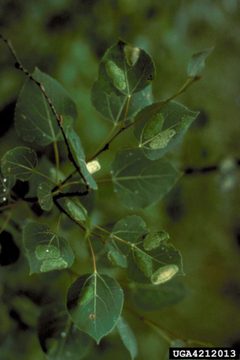
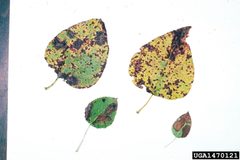
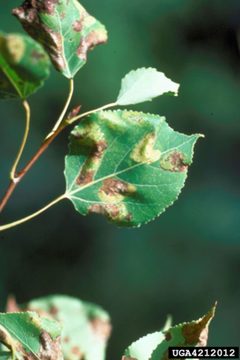
A small leaf-mining in the Gracillariidae with a wingspan of 8.5–10 mm. Larvae create blotch mines on aspen and related poplar , with each mine housing a single larva. The species has one per year and is found across most of Europe, Turkey, and North America.
Pronunciation
How to pronounce Phyllonorycter apparella: /ˌfɪloʊnəˈrɪktər ˌæpəˈrɛlə/
These audio files are automatically generated. While they are not always 100% accurate, they are a good starting point.
Identification
Distinguished from other Phyllonorycter by association with aspen (Populus tremula) and gray poplar (Populus canescens) , and by the blotch mine structure with clumped in a corner. Larval mines may reach densities of up to 26 per leaf. occurs within the mine in a white cocoon. Specific identification requires examination of genitalia or molecular methods.
Images
Appearance
Wingspan 8.5–10 mm. Small with typical Phyllonorycter : narrow wings with distinctive patterning characteristic of the . are minute and require magnification for reliable identification.
Habitat
Forested and riparian areas supporting poplar , particularly aspen (Populus tremula) stands. In North America, associated with trembling aspen and related Populus species in and temperate forest zones.
Distribution
Most of Europe excluding the British Isles, Iberian Peninsula, Balkan Peninsula, and Mediterranean islands. Present in Turkey and North America. In North America: recorded from Alberta, British Columbia, Manitoba, Nova Scotia, and Ontario in Canada; distribution extends into the United States.
Seasonality
One per year. activity period not explicitly documented in sources; inferred to align with typical Phyllonorycter in temperate regions.
Diet
Larvae feed on Populus canescens (gray poplar) and Populus tremula (European aspen). Mining occurs within leaves; no other feeding stages or diet documented.
Host Associations
- Populus tremula - larval Primary ; European aspen
- Populus canescens - larval Gray poplar
- Populus nigra - larval Black poplar; documented in Russia
Life Cycle
(one per year). Larvae mine leaves of poplars, creating blotch mines with accumulated in one corner. Each mine contains a single larva. occurs within the mine in a white silken cocoon. Detailed -laying and stage not explicitly documented.
Behavior
Larvae are leaf miners, feeding between leaf layers. Each larva occupies an individual mine; leaves may support multiple mines simultaneously. No documented behavioral traits beyond typical activity patterns.
Ecological Role
Herbivore of poplar foliage as larvae. for diverse hymenopteran complex (Eulophidae, Braconidae); 26+ parasitoid documented. During conditions in Russia, parasitoids became the mortality factor (69.8% mortality in 2017), contributing to collapse. Parasitoid structure shifts annually during outbreak progression.
Human Relevance
Documented as a pest of trembling aspen in Turkey. can cause significant defoliation of aspen stands, with economic and ecological implications for forestry. Subject of research focusing on -mediated .
Similar Taxa
- Phyllonorycter populifoliellaAlso a leaf-mining on Populus ; complex shows high similarity (Jaccard coefficient 0.65). Distinguished by preferences and mine details requiring expert examination.
- Phyllonorycter speciesNumerous mine leaves of various tree ; identification to species level typically requires association, mine characteristics, and genitalia dissection.
More Details
Outbreak Dynamics
In the Middle Volga basin of Russia, studied showed increasing from 6 to 19 over 2014–2017, with 8 species newly recorded for this . Parasitoid rates increased from 7.4% to 19.6% annually, ultimately causing outbreak collapse through -dependent mortality.
Taxonomic History
Originally described as Tinea apparella by Herrich-Schäffer in 1855; later transferred to Phyllonorycter. The epithet and authorship are sometimes cited with variant spellings (Herrich-Schäffer vs. Herrich-Schaffer).
Sources and further reading
- BugGuide
- Wikipedia
- GBIF taxonomy match
- iNaturalist taxon
- NCBI Taxonomy
- Catalogue of Life
- Bug Eric: My Personal National Moth Week, 2017
- Bug Eric: September 2017
- Eulophidae (hymenoptera) parasitoids of Phyllonorycter apparella and phyllonorycter populifoliella (Lepidoptera, Gracillariidae), pests of Populus tremula and populus nigra in Ul’yanovsk province, Russia
- Parasitoids (Hymenoptera, Eulophidae, Braconidae) as a Mortality Factor for the Aspen Leafminer Phyllonorycter apparella (Lepidoptera, Gracillariidae) in Its Outbreak Site in Udmurtia
- Changes in the Structure of the Parasitoid Complex (Hymenoptera, Eulophidae, Braconidae) in an Outbreak Focus of the Aspen Leafminer (Phyllonorycter apparella, Lepidoptera, Gracillariidae)