
Caloptilia violacella
(Clemens, 1860)
Tick-Trefoil Caloptilia Moth
Caloptilia violacella is a small gracillariid with a wingspan of approximately 10 mm. The is distributed across the eastern and central United States, with records from Illinois, Missouri, Florida, Georgia, Kentucky, Maine, Maryland, New York, and Texas. Larvae are leaf miners that feed on leguminous plants including pigeon pea (Cajanus cajan), -trefoils (Desmodium species), and Meibomia dillenii. The "Tick-Trefoil Caloptilia Moth" reflects its association with Desmodium host plants.
Pronunciation
How to pronounce Caloptilia violacella: //kæˌlɒpˈtɪliə ˌvaɪoʊləˈsɛlə//
These audio files are automatically generated. While they are not always 100% accurate, they are a good starting point.
Identification
can be recognized by their small size (approximately 10 mm wingspan) and the typical Caloptilia resting posture with wings held tent-like. Definitive identification likely requires examination of genitalia or , as many Caloptilia are externally similar. The species is distinguished from congeneric by geographic distribution and, more reliably, by larval plant association with Desmodium, Cajanus, and Meibomia. Similar small gracillariids in the same range include other Caloptilia species, which may require dissection for confident separation.
Images
Appearance
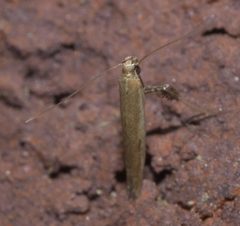
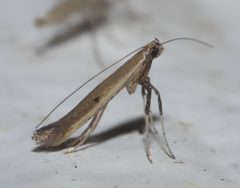
are small with a wingspan of about 10 mm. As a member of the Caloptilia, adults likely exhibit the characteristic resting posture with wings held steeply roof-like over the body, creating a slender, elongate silhouette. Specific coloration and pattern details for this are not well documented in available sources. The small size and gracillariid body plan distinguish it from larger moth .
Habitat
Associated with supporting its leguminous plants, including open woodlands, forest edges, and disturbed areas where Desmodium and related plants occur. Specific habitat preferences of the are poorly documented, but larvae require living host plants for leaf mining.
Distribution
Eastern and central United States. Documented from Illinois, Missouri, Florida, Georgia, Kentucky, Maine, Maryland, New York, and Texas. Canadian records include Ontario and Quebec. The distribution corresponds broadly with the range of its Desmodium plants.
Diet
Larvae feed internally as leaf miners on leaves of Cajanus cajan (pigeon pea), Desmodium including Desmodium rotundifolium (-trefoils), and Meibomia dillenii. feeding habits are not documented.
Host Associations
- Cajanus cajan - larval pigeon pea
- Desmodium rotundifolium - larval roundleaf -trefoil
- Desmodium - larval -trefoils, level
- Meibomia dillenii - larval
Life Cycle
Larvae mine leaves of plants, feeding internally between leaf surfaces. The complete has not been described in detail. likely occurs within the mine or in a silken cocoon on the host plant, as is typical for Gracillariidae. Number of per year is unknown.
Behavior
are and attracted to ultraviolet light sources, as evidenced by blacklight sampling during National Week events. Larvae are leaf miners, remaining within plant leaves during feeding stages.
Ecological Role
As a leaf-mining herbivore, larvae modify plant tissue and may influence leaf physiology. The contributes to local biodiversity and serves as a food source for and . Specific ecological impacts are unstudied.
Human Relevance
No significant direct economic importance. The is occasionally encountered by enthusiasts during blacklighting events and contributes to citizen science datasets. Potential minor relevance in agricultural contexts where pigeon pea (Cajanus cajan) is cultivated, though not documented as a significant pest.
Similar Taxa
- Caloptilia blandellaWalnut Caloptilia, similar size and appearance but associated with Juglandaceae (walnut ) rather than legumes; distinguished by host plant and likely genitalia
- Other Caloptilia speciesNumerous congeneric overlap in size and general ; reliable separation requires plant association or genitalia examination