
Caloptilia stigmatella
(Fabricius, 1781)
Willow Leafcone Caterpillar Moth
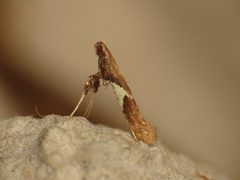
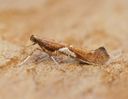
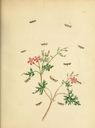
A small leaf-mining in the Gracillariidae with a wingspan of 12–14 mm. display distinctive red-brown forewings with a triangular white costal blotch marked with blackish dots, and grey hindwings. The has two adult periods annually and larvae feed on leaves of willows, poplars, and bog myrtle. It occurs across the Holarctic region, excluding the Balkan Peninsula.
Pronunciation
How to pronounce Caloptilia stigmatella: /kæˈlɒptɪliə ˌstɪɡməˈtɛlə/
These audio files are automatically generated. While they are not always 100% accurate, they are a good starting point.
Identification
Distinguished from similar Caloptilia by the triangular white costal blotch on the forewing, marked with blackish dots and emitting an oblique streak toward the dorsum. The specific wing pattern of red-brown ground color with contrasting white blotch provides field identification characters. Virtual descaling of wings via micro-CT reveals diagnostic venation characters useful for separating closely related species.
Images
Appearance
Small with wingspan 12–14 mm. Forewings red-brown, darkest toward costal blotch; triangular white costal blotch usually mixed with brown-reddish, marked with several blackish dots on , with apex emitting a slender outwardly oblique streak toward dorsum. Hindwings grey. Larva green-whitish with yellowish marked with brown.
Habitat
Associated with plants including willows (Salix ), poplars (Populus species), and bog myrtle (Myrica gale). include riparian zones, wetlands, and areas supporting these host plants.
Distribution
Holarctic region. Europe: all countries except Balkan Peninsula. North America: recorded from Canada (Alberta, British Columbia, Manitoba, New Brunswick, Nova Scotia).
Seasonality
on wing in late June and July, and again from September onwards. pattern with two distinct adult periods.
Diet
Larvae feed on leaves of Myrica gale, Populus alba, Populus candicans, Populus canescens, Populus nigra, Populus tremula, Salix alba, Salix aurita, Salix babylonica, Salix cinerea, Salix dasyclados, Salix elaeagnos, Salix fragilis, Salix glaucosericea, Salix lanata, Salix magnifica, Salix myrsinifolia, Salix pentandra, Salix purpurea, Salix repens, Salix sitchensis, Salix spadicea, Salix × stipularis, Salix triandra, Salix udensis, and Salix viminalis.
Host Associations
- Myrica gale - larval bog myrtle
- Populus alba - larval white poplar
- Populus tremula - larval aspen
- Salix alba - larval white willow
- Salix fragilis - larval crack willow
- Salix viminalis - larval osier
Life Cycle
Larvae mine leaves of plants. Specific details of and stage not documented in available sources.
Behavior
Larvae are leaf miners, feeding internally within plant leaves. attracted to ultraviolet light sources.
Ecological Role
on willows, poplars, and bog myrtle. Contributes to herbivore diversity in riparian and wetland .
Human Relevance
No significant economic importance documented. Occasionally encountered during surveys and biodiversity monitoring.
Similar Taxa
- Caloptilia blandellaSimilar size and wing pattern; distinguished by specific forewing markings and plant associations
- Other Caloptilia speciesWing venation and pattern details require examination; micro-CT virtual dissection of enables diagnostic comparison
Sources and further reading
- BugGuide
- Wikipedia
- GBIF taxonomy match
- iNaturalist taxon
- NCBI Taxonomy
- Catalogue of Life
- Bug Eric: Remembering National Moth Week 2018
- Bug Eric: It's National Moth Week Already?!
- Bug Eric: October 2018
- A non-destructive virtual dissection by micro-CT reveals diagnostic characters in the type specimen of Caloptilia stigmatella (Lepidoptera: Gracillariidae)