
Caloptilia populetorum
(Zeller, 1839)
clouded slender
Caloptilia populetorum is a small leaf-mining in the Gracillariidae, commonly known as the clouded slender. Despite its suggesting an association with poplars, the larvae feed exclusively on birch leaves (Betula ). The species is found across most of Europe and extends into parts of Russia. are active from late summer through spring, as adults.
Pronunciation
How to pronounce Caloptilia populetorum: /kæˌlɒptɪˈlaɪə pɒpjʊlɛˈtɔːrʌm/
These audio files are automatically generated. While they are not always 100% accurate, they are a good starting point.
Identification
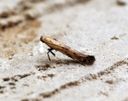
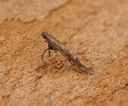
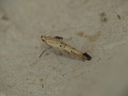
Distinguished from similar Caloptilia by the combination of whitish ochreous forewings with irregular fuscous clouding, black marginal dots, and specific spot pattern on and fold. The dark grey hindwings contrast with the lighter forewings. Larval on Betula (birch) rather than Populus (poplar) helps distinguish from related species despite the misleading specific epithet.
Images
Appearance
Small with wingspan of 11–14 mm. Forewings whitish ochreous, irregularly clouded and tinged with fuscous; margins dotted with black; small black spot on middle of ; blackish dots on fold at one-third and two-thirds. Hindwings dark grey. Larva greenish-white with very pale brownish .
Habitat
Associated with birch woodlands and areas where Betula occur. Larval is within birch leaves, initially in galleries and later in rolled leaves.
Distribution
Most of Europe except Italy, the Balkan Peninsula, and Mediterranean islands. Extends eastward into Russia (European Central region, Altai Republic, Amur Oblast, Chita Oblast).
Seasonality
on wing from August onwards, and reappearing until April or May. or partially bivoltine pattern with adult activity spanning late summer through spring.
Diet
Larvae feed exclusively on leaves of Betula , including Betula pendula and Betula pubescens. do not feed.
Host Associations
- Betula pendula - larval silver birch
- Betula pubescens - larval downy birch
Life Cycle
Larva initially mines gallery within birch leaf, then rolls leaf edge and continues feeding within the shelter. occurs within the rolled leaf. emerges in late summer, overwinters, and may be seen until spring.
Behavior
overwinter, suggesting they seek sheltered during cold months. Larvae construct progressively more complex shelters, transitioning from internal leaf mining to external leaf rolling.
Ecological Role
and roller on birch; contributes to leaf litter processing and nutrient cycling in birch woodland . Provides food source for and .
Human Relevance
Minor significance; occasionally noted in biodiversity surveys and recording schemes. Not an agricultural or forestry pest.
Similar Taxa
- Caloptilia stigmatellaAlso feeds on birch and poplar; distinguished by different wing pattern and larval
- Other Caloptilia speciesMany similar in size and general appearance; precise identification requires examination of genitalia or larval association
Misconceptions
The specific epithet 'populetorum' (of poplars) is misleading; larvae do not feed on poplar but exclusively on birch . This appears to be a historical taxonomic error.
More Details
Etymology
The misleading specific epithet 'populetorum' derives from Latin 'populus' meaning poplar, though the has no confirmed association with Populus species.
Larval shelter construction
Larvae exhibit progressive shelter-building : initial mining phase followed by leaf-rolling, a trait common in Gracillariidae but with -specific variations in timing and structure.