
Idaea dimidiata
(Hufnagel, 1767)
Single-dotted Wave
Idaea dimidiata is a small Geometrid with a Holarctic distribution. are active from June to August and are attracted to light. The has shown significant phenological shifts in response to climate change over recent decades.
Pronunciation
How to pronounce Idaea dimidiata: /ɪˈdiː.ə dɪˌmɪd.iˈɑː.tə/
These audio files are automatically generated. While they are not always 100% accurate, they are a good starting point.
Identification
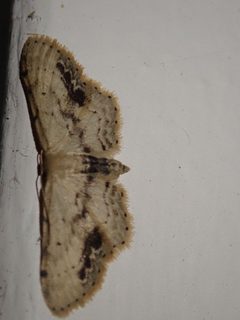
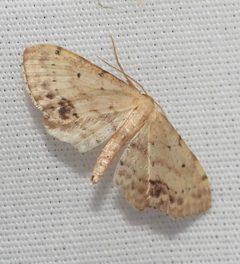
Distinguished from similar Idaea by the combination of: single prominent discal fleck on each wing (though occasionally weak on forewings); interrupted or incomplete band with costal stains; and the light wavy line limited mainly to the inner edge of the wing. The straw-white forewing colouration and dark marks to the half of the third forewing line are additional diagnostic features.
Images
Habitat
Damp locations including marshy woodland, fens, river banks, and other wet grassland . Occurs across a wide range of habitats from woodland to marshes.
Distribution
Holarctic. Western Palearctic: widespread in West, South and Central Europe, extending north to South Scandinavia and east to the Urals. Found on almost all Mediterranean islands; also in Morocco, Northwestern Turkey, Caucasus, Transcaucasia, North Iran, Afghanistan, and Central Asia. Nearctic: Canada and northern United States. In Britain, common and well distributed throughout England, Ireland, Wales and Isle of Man; local in southern Scotland; rarely recorded further north. British distribution has increased significantly since 1970.
Seasonality
fly from June to August, occasionally later. . Overwinters as larva from end of August to May.
Diet
Wild larvae feed on flowers of hedge bedstraw (Galium mollugo), cow parsley (Anthriscus sylvestris), and burnet-saxifrage (Pimpinella saxifraga). In captivity may accept herbaceous plants.
Life Cycle
. laid in summer. Larva overwinters from end of August to May, feeding on flower of plants. Pupates in plant debris. June to August.
Behavior
; fly at night and are attracted to light. Visits flowers between dawn and dusk during season. Has demonstrated ability to significantly alter over 35-year period in response to increased temperatures.
Similar Taxa
- Idaea rusticataSimilar size and wing pattern, but I. dimidiata distinguished by interrupted band with costal stains and single discal fleck pattern
- Idaea biselataOverlaps in and distribution; I. dimidiata has more prominent discal flecks and characteristic costal staining
More Details
Genome
Chromosomally complete assembly of 422.6 Mb generated from male specimen in Oxfordshire, UK. Assembly includes 20 chromosomal pseudomolecules (19 + Z ) and 17.04 kb mitochondrial genome, with 18,351 protein-coding genes annotated.
Climate response
Documented phenological shift: has advanced period significantly over 35-year study period in response to rising temperatures.
Subspecies
In Cyprus, Turkey and the Levant, I. d. antitaurica replaces the nominate subspecies.