
Spargania luctuata
(Denis & Schiffermüller, 1775)
White-banded Carpet, White-banded Carpet Moth
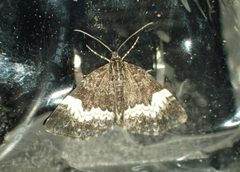
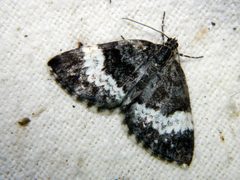
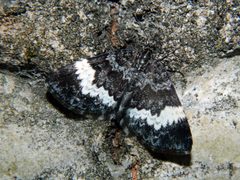
Spargania luctuata, commonly known as the white-banded carpet, is a geometrid with a Holarctic distribution spanning northern and central Europe, North Asia, and North America. are in at least parts of their range, flying from late April through September. The is recognized by its characteristic wing pattern featuring a prominent white transverse band. Larvae feed specifically on rosebay willowherb (Chamaenerion angustifolium and related species).
Pronunciation
How to pronounce Spargania luctuata: //spɑːrˈɡeɪniə lʌkˈtjuːətə//
These audio files are automatically generated. While they are not always 100% accurate, they are a good starting point.
Identification
The white transverse band across both forewings and hindwings distinguishes this from other carpet moths in the Spargania and similar geometrids. Wing measurements (30–34 mm wingspan, 14–15 mm forewing length) provide additional diagnostic characters. Genitalia examination may be required for definitive identification from closely related species.
Images
Appearance
wingspan 30–34 mm; forewing length 14–15 mm. Wings display a distinct white transverse band across the forewings and hindwings, contrasting with darker ground coloration. Pattern and banding serve as the primary visual recognition features.
Habitat
Associated with supporting its larval plant, rosebay willowherb. This includes disturbed ground, woodland clearings, riverbanks, and open areas where willowherb colonizes. Specific habitat preferences for are not well documented.
Distribution
Holarctic distribution: recorded throughout northern and central Europe, North Asia (excluding China), and North America. Present in Belgium including the Antwerpen province and Walloon Region.
Seasonality
period in Belgium and the Netherlands: two from late April to September. Timing may vary across the range.
Diet
Larvae feed on various of rosebay willowherb (Chamaenerion angustifolium and related in Onagraceae). feeding habits are not documented.
Host Associations
- Chamaenerion angustifolium - larval plantrosebay willowherb; primary documented
Life Cycle
Two per year in at least parts of the range (Belgium/Netherlands). Complete with , larval, pupal, and stages. and stage not specified in available sources.
Ecological Role
Herbivore as larvae, specializing on willowherb . Specific ecological functions (pollination, prey base, etc.) are not documented.
Human Relevance
No documented economic or agricultural significance. Occasionally encountered by naturalists and enthusiasts. Not considered a pest .
Similar Taxa
- Other Spargania speciesSimilar wing patterns and size; require examination of genitalia or precise banding patterns for separation
- Other Larentiinae carpet mothsShared geometrid ; white-banded pattern is distinctive but may be approached by some Epirrhoe or Xanthorhoe
More Details
Nomenclature
Originally described by Michael Denis and Ignaz Schiffermüller in 1775. The Spargania is placed in Larentiinae.
Flight season note
The documented pattern (April–September) specifically refers to Belgium and the Netherlands; likely varies with latitude and climate across the Holarctic range.