
Xanthorhoe
Hübner, [1825]
Species Guides
15- Xanthorhoe abrasaria(Northern Carpet)
- Xanthorhoe alticolata
- Xanthorhoe columelloides
- Xanthorhoe decoloraria(Red Carpet)
- Xanthorhoe defensaria
- Xanthorhoe dentilinea
- Xanthorhoe ferrugata(Dark-barred Twin-spot Carpet)
- Xanthorhoe fossaria
- Xanthorhoe iduata(Broken-banded Carpet)
Xanthorhoe is a of carpet moths in the Geometridae, Larentiinae. The genus was established by Jacob Hübner in 1825 and contains numerous distributed across the northern Palaearctic region. Several species are widespread and common, while others have restricted distributions. The genus is characterized by distinctive wing patterns with bands or lines, and larvae are typically associated with herbaceous plants. Some species have experienced declines, including Xanthorhoe bulbulata in New Zealand, which is feared possibly extinct.
Pronunciation
How to pronounce Xanthorhoe: //zænˈθɔːrəʊiː//
These audio files are automatically generated. While they are not always 100% accurate, they are a good starting point.
Identification
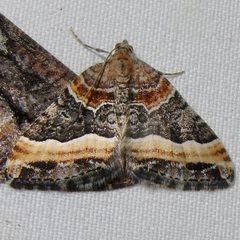
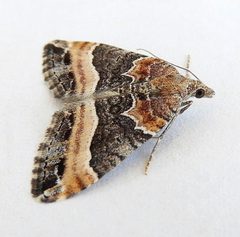
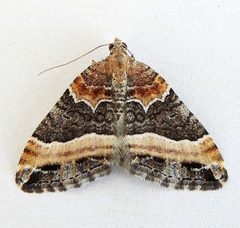
identified by forewing pattern: distinct pale reddish, purplish, or brownish central band with dark lines on grey or brown background. Similar include other Larentiinae carpet moths; Xanthorhoe distinguished by specific band configuration and coloration. Larvae extremely difficult to distinguish from related Xanthorhoe ; rearing to adult stage required for definitive identification. Genitalia examination often necessary for species-level identification.
Images
Habitat
Diverse including gardens, woodland edges, grasslands, upland moors, and taiga zones. Many occur in open or semi-open environments with herbaceous vegetation.
Distribution
Widespread across northern Palaearctic region, including Europe, Asia, and North America. Some common and widespread throughout Britain and northern Europe; others have more restricted ranges. Xanthorhoe inconsiderata with limited distribution. Xanthorhoe bulbulata (New Zealand endemic) feared possibly extinct.
Seasonality
Variable by and region. In Britain, many species with two : spring generation peaking May-June, summer generation August. Spring has shifted earlier in recent decades for some species. generally , attracted to light traps.
Diet
Larvae feed on herbaceous plants. Xanthorhoe designata larvae readily consume Brassicaceae in captivity and have been found in withered leaves of Mugwort (Artemisia vulgaris, Asteraceae). Specific plants poorly documented for many due to larval identification difficulties.
Life Cycle
Holometabolous. laid on plants. Larvae feed internally or externally on leaves; some form leaf mines. occurs in soil or leaf litter. Multiple per year in temperate regions; some species overwinter as larvae or pupae. Xanthorhoe designata has two generations annually in Britain.
Behavior
, readily attracted to artificial light. Larvae of some construct silk webs or leaf mines. Defensive not well documented.
Ecological Role
Larvae function as herbivores, consuming herbaceous vegetation. may contribute to pollination as nectar feeders. Serve as prey for birds, bats, and insectivorous arthropods. declines of some may indicate broader changes.
Human Relevance
Some considered minor agricultural pests when larvae feed on cultivated Brassicaceae. Used as bioindicators for quality and climate change effects. Subject of ecological and genetic research; Xanthorhoe designata sequenced (351.47 Mb, 12,291 protein-coding genes). Light-trapped for scientific monitoring and citizen science observations.
Similar Taxa
- Other Larentiinae carpet moths (e.g., Cidaria, Euphyia)Similar wing patterns and body form; distinguished by specific forewing band configuration and genitalia structure.
- Xanthorhoe spadicearia and X. ferrugataLarvae virtually indistinguishable from X. designata; identification requires examination of wing pattern details or genitalia.
More Details
Conservation concerns
Xanthorhoe bulbulata, a New Zealand , has declined drastically and is feared possibly extinct; its and plant remain undiscovered.
Research significance
of Xanthorhoe designata sequenced, providing 351.47 Mb assembly with 31 chromosomal pseudomolecules including W and Z .
Sources and further reading
- BugGuide
- Wikipedia
- GBIF taxonomy match
- iNaturalist taxon
- NCBI Taxonomy
- Catalogue of Life
- Alpine Entomology | Blog - Part 2
- On the Distribution of an Endemic Geometrid Moth, Xanthorhoe inconsiderata (Staudinger, 1892) (Lepidoptera)
- The genome sequence of the Flame Carpet moth, Xanthorhoe designata (Hufnagel, 1767) (Lepidoptera: Geometridae).